
CHI 2026 Paper
Kim Young-Ho, Leader (HCI Research, NAVER AI Lab)
This post introduces a NAVER Cloud paper presented at ACM CHI 2026, the leading international conference on human-computer interaction (HCI), held this April in Barcelona, Spain.
LingoQ: Bridging the Gap between EFL Learning and Work through AI-Generated Work-Related Quizzes
Yang Yeonsun (DGIST / NAVER AI Lab intern)
Lee Sang Won (Virginia Tech / NAVER AI Lab visiting researcher)
Song Jean Young (Yonsei University)
Yun Sangdoo (NAVER AI Lab)
Kim Young-Ho (NAVER AI Lab)
We work in English every day. Why isn’t our English getting better?
You paste a draft English email into ChatGPT, ask it to “make this sound more natural,” then copy the revised version and hit send. If you work in a global environment, this is probably a familiar scene. You read documents and write emails in English every day, and yet somehow your English feels stuck.
For non-native English-speaking knowledge workers, English proficiency directly affects productivity. Reading the same document takes longer than it does for a native speaker, and writing the same email means spending extra time agonizing over a single phrase. Many people turn to apps like Duolingo to close the gap, but most of the content centers on travel, everyday conversation, or general business expressions—a long way from the industry-specific terminology, report-style phrasing, and practical writing that actually come up at work.
The problem isn’t studying—it’s sticking with review
Couldn’t we just collect the English we encounter at work and review it later? Some workers do exactly that—saving unfamiliar words in Notion or Google Docs, building flashcard quizzes in Anki. But a “good” method and a “sustainable” method aren’t the same thing.
In a preliminary survey of 49 non-native English-speaking knowledge workers, most said keeping up a manual review routine was hard. More than half (33 of 49) felt they needed to study English for work, but fewer than half actually did. Even those taking English classes or using apps like Duolingo said their motivation faded because the content felt disconnected from their actual work.
LingoQ: Turning your AI English questions into study material
Many readers have probably asked ChatGPT, Gemini, or another large language model (LLM) to interpret or help draft English at work. Our preliminary survey backs this up: 94% of respondents said they use LLM-based AI for work tasks. The most common uses were looking up the meaning of unfamiliar words or phrases, translating sentences or paragraphs between English and Korean, and revising English drafts. That raised a question: “What if our English questions to AI were automatically turned into quizzes we could review later—would that actually improve our English?” That question led our research team to build LingoQ.
LingoQ follows a simple flow—ask AI an English question at work, automatically generate a quiz from it, then review on mobile—turning real English struggles into personalized study material. The key idea is that, unlike conventional English-learning apps that hand everyone the same content, the expressions you actually encountered at work become your study material. The word you wondered about, the sentence you needed translated, the email phrasing that was corrected for you—all of these come back as quizzes you can review later, so the learning is rooted in your actual work.
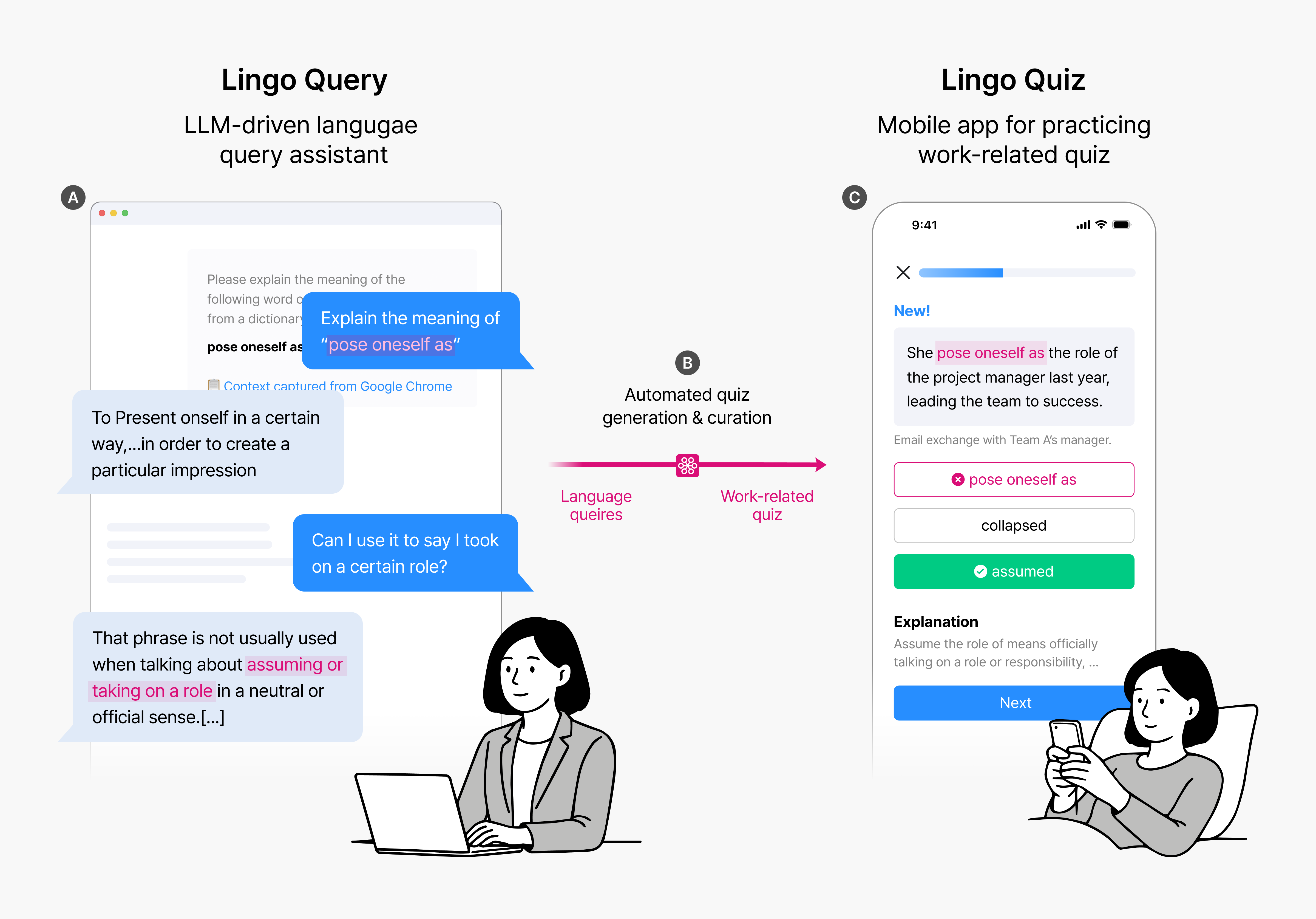
A: LingoQuery, a desktop AI assistant for work-related English queries
B: An automated pipeline that generates TOEIC-style questions from the user’s English conversations with AI
C: LingoQuiz, a mobile app for practicing with the generated quizzes
LingoQ has three components:
- LingoQuery: a desktop AI assistant where you can freely ask work-related English questions
- Quiz generation pipeline: a background system that automatically generates TOEIC-style questions from LingoQuery’s English conversations
- LingoQuiz: a mobile app for solving the generated quizzes in spare moments
1. LingoQuery: A desktop AI assistant built for English at work
LingoQuery’s interface looks much like a general-purpose desktop AI assistant such as ChatGPT or Gemini, but it adds a few touches built specifically for work-related English.
The biggest is one-button access to the three prompt types workers use most often: Look up (word and phrase meanings), Translate, and Proofread. Instead of typing out a prompt each time, users just copy the text, pick an action, and send.
Each of these has its own response interface. Translations show the source and translation side by side for easy comparison, and proofreading results highlight edits in a track-changes style so you can see exactly what was changed and how.
For moments when you want to look up or translate something while reading another document, users can select text in any browser or app and hit a keyboard shortcut to send it straight to LingoQuery. The system also captures a screenshot of what’s on screen, so the AI has a clearer picture of the work context—whether you’re drafting a report, reviewing an email, or making sense of an industry-specific document. That kind of situational background is hard to capture in text alone, and it feeds back into quiz generation later. Screenshots can be excluded before sending when the content is sensitive.
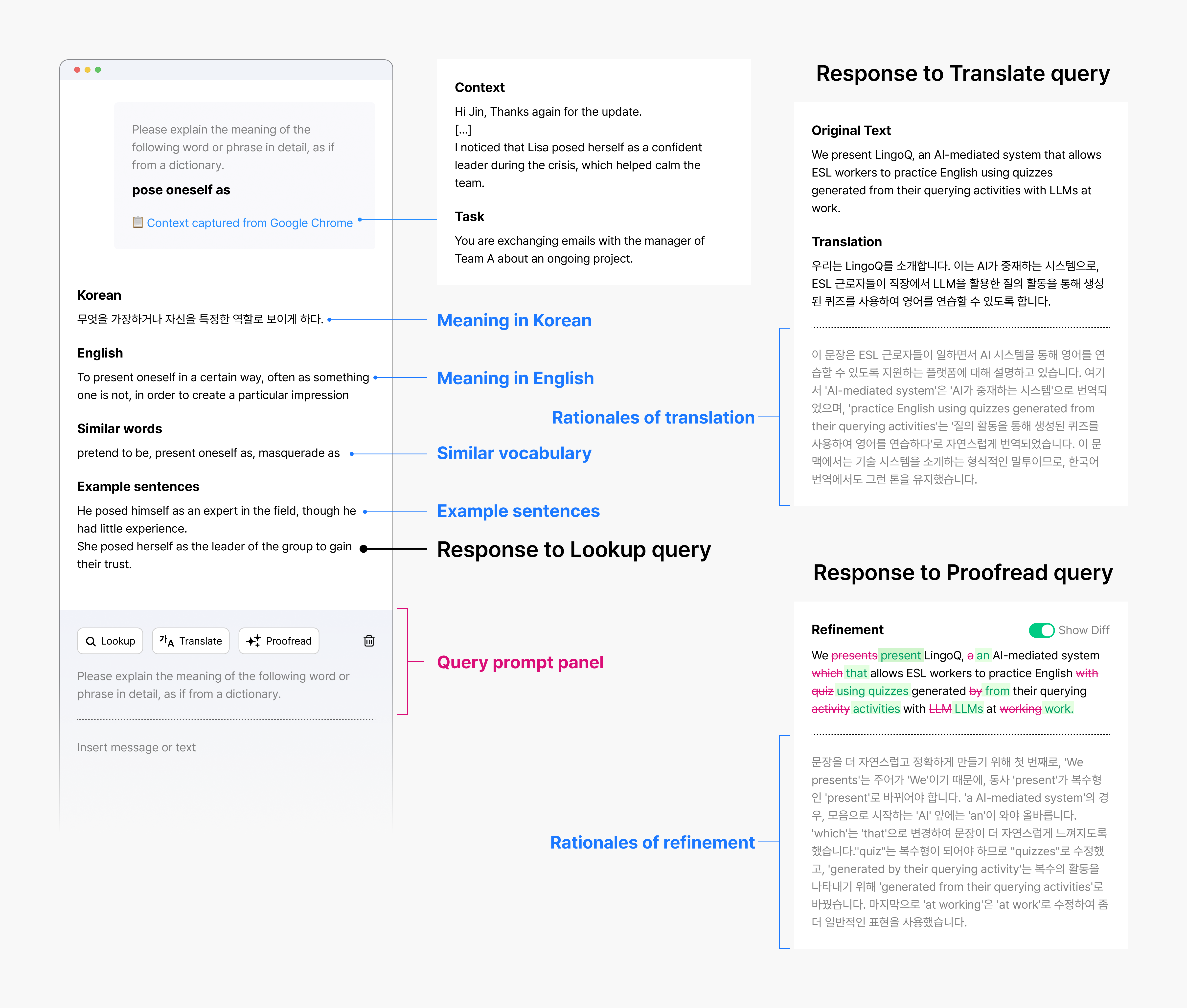
▲ LingoQuery’s interface components
2. Quiz generation pipeline: Building personalized English quizzes from AI conversations
All this accumulated conversation data feeds into the quiz generation pipeline. The pipeline keeps only the English-related pairs from LingoQuery’s stored question-answer history, then automatically generates two TOEIC-style fill-in-the-blank multiple-choice questions from each conversation. The key point is that the questions don’t just cover the word or expression itself—the real work context extracted from the screenshot is folded into the question stem. The result isn’t dictionary-style drilling, but personalized questions tied to the situations the user actually encountered at work.
Question quality is verified automatically too. Each generated item is evaluated by AI on two criteria: answerability and difficulty appropriateness. The first checks whether the question has one clearly correct answer; the second flags items too easy to offer real learning value. Questions that fail either check go through up to two rounds of automatic revision.
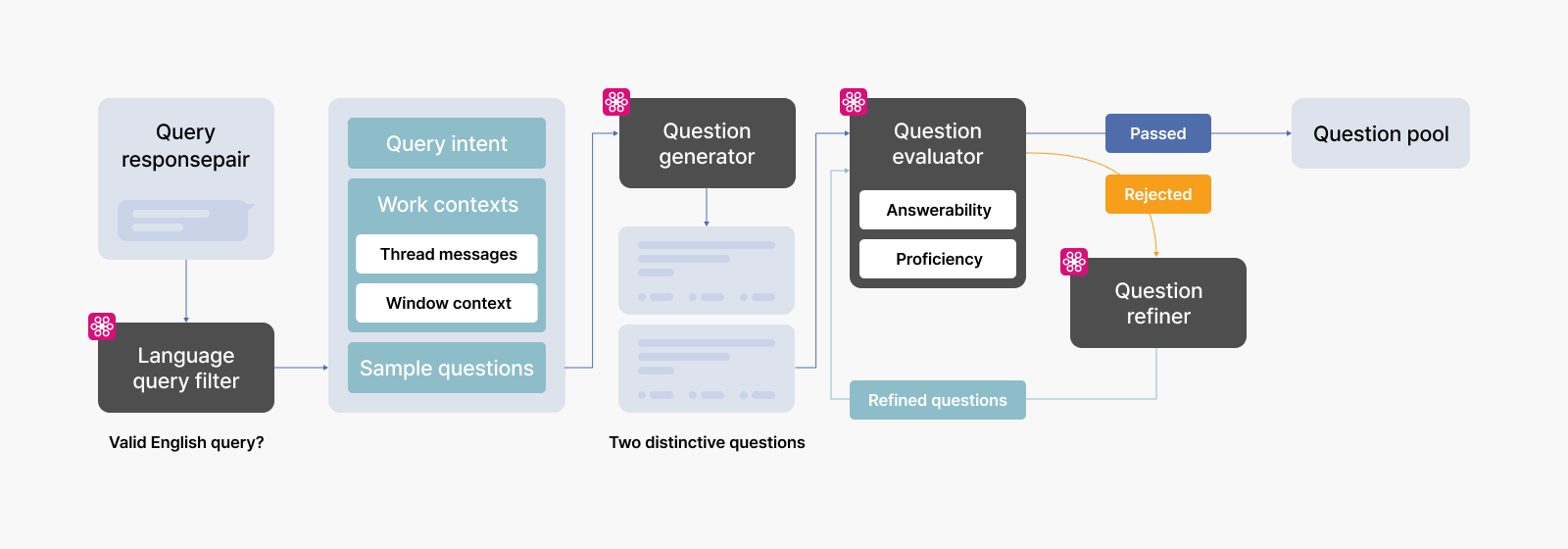
▲ LingoQ’s quiz generation pipeline
Following the user study, English-education experts with experience writing TOEIC questions reviewed the generated questions and judged them to be on par with TOEIC and TOEFL fill-in-the-blank items. They especially highlighted questions tied to a particular industry or profession, which require domain-specific knowledge and could offer practical learning value to people in that field.
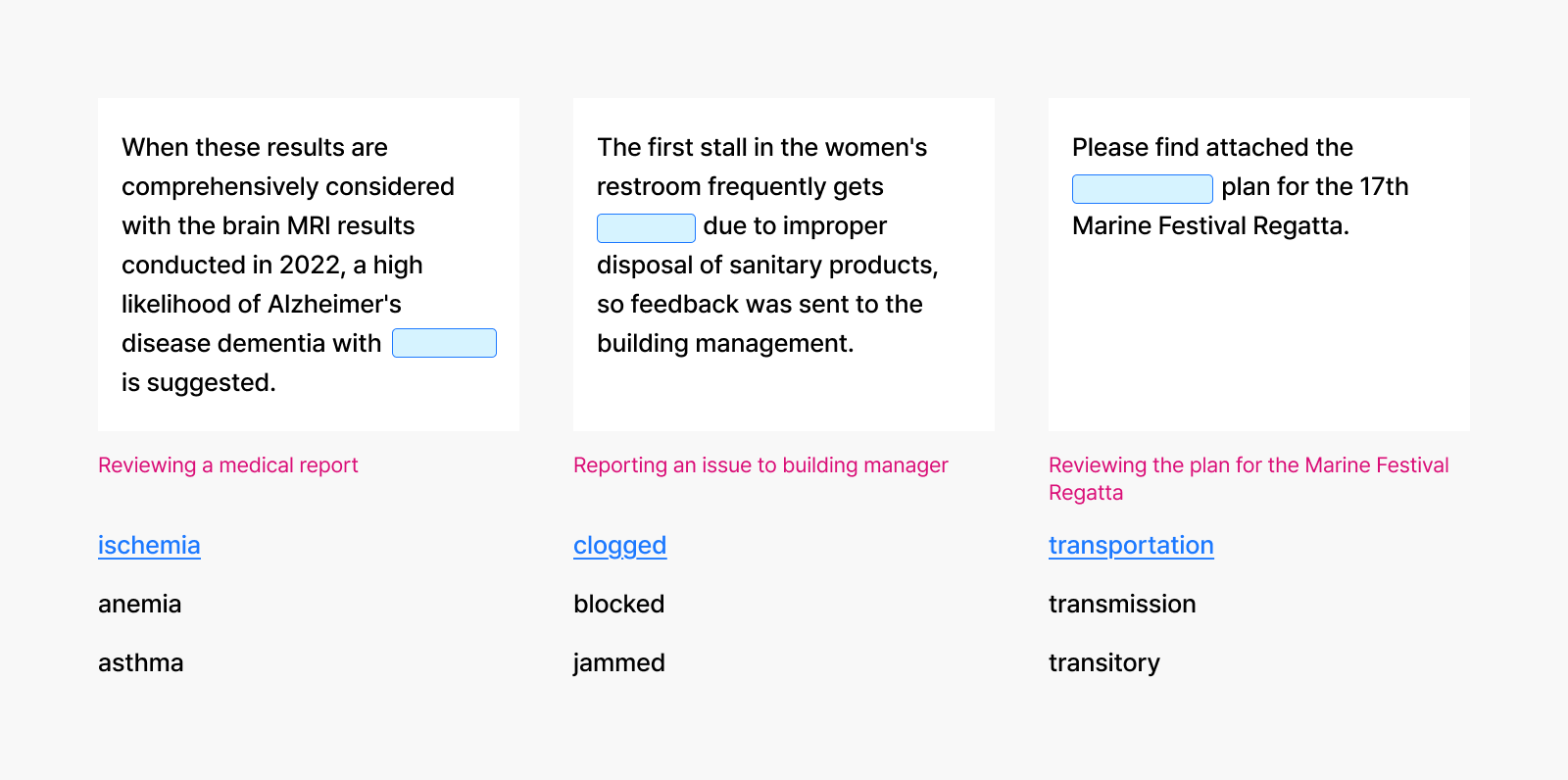
▲ Sample English questions presented to study participants
3. LingoQuiz: A mobile review app that turns spare moments into skill
LingoQuiz lets users review the generated questions in spare moments throughout the day. Each day, users get a set of 10 questions: 7 are freshly generated, and 3 are pulled from past misses or items the user hasn’t seen in a while. The mix keeps new learning and review in balance. Each question comes with an AI-generated explanation showing why a given option is right or wrong. After the initial 10, any items missed in the session loop back into the queue, and the session only ends once every question has been answered correctly.
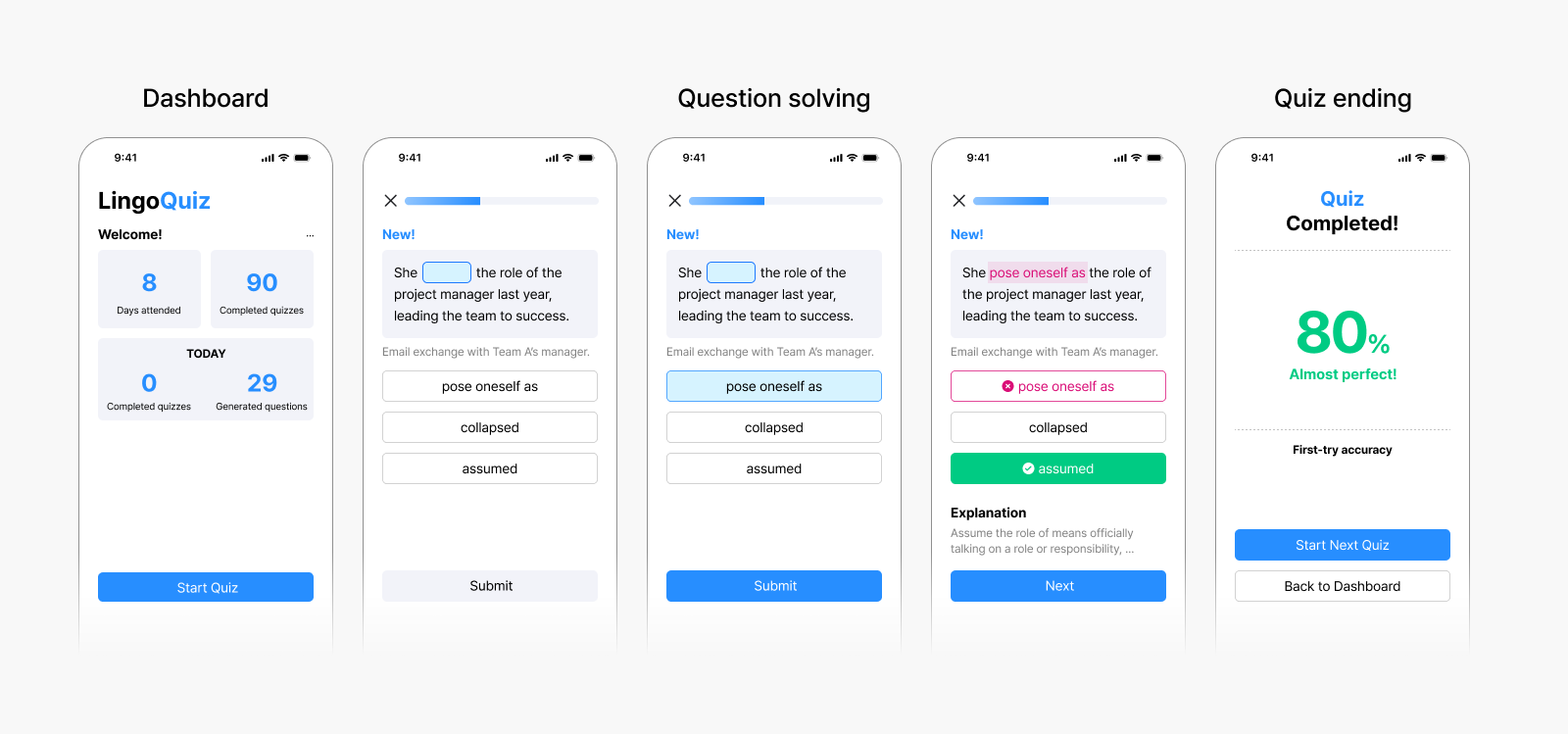
▲ LingoQuiz’s main screens
User study: Putting LingoQ to the test
To see how effective learning with LingoQ actually was, we ran a three-week user study with 28 non-native English-speaking knowledge workers. Participants spanned a range of roles—researchers, software engineers, healthcare workers, marketers—and their self-rated English levels were evenly distributed from CEFR A1 (beginner) to C1 (advanced). For three weeks, participants used LingoQuery in place of their usual AI tools (such as ChatGPT) for English-related work, and used LingoQuiz at their own pace. Before and after the study, we measured changes with an English proficiency test based on released TOEIC questions and the Questionnaire of English Self-Efficacy (QESE).
Sustained use and steady practice
The first thing that stood out was how consistently people used the apps. Participants opened LingoQuery on most weekdays, leaving roughly 120 English-related questions per person. They also completed an average of one LingoQuiz session per day, meaning they studied English daily throughout the study. Usage clustered around 10 p.m., suggesting that learning had naturally settled into the spare moments after the commute or before bed.
Compared to what they’d tried before, LingoQ also held up. Before and after the study, participants rated the sustainability of both their previous approach and learning with LingoQ—and LingoQ scored significantly higher (𝑝 < 0.001).
“The quizzes themselves didn’t feel heavy, and they naturally became part of my routine on the commute and before bed.”
– Participant 3
Gains in English self-efficacy
The clearest change after three weeks was in English self-efficacy (QESE). Participants’ QESE scores rose by an average of 9.5% (𝑝 < 0.001), with significant gains on both the reading and writing subscales. Participants said that revisiting expressions they had repeatedly encountered at work reduced the anxiety they felt around English and made them feel more confident.
“The biggest change was confidence. After going over the parts I kept getting wrong, at some point even complicated sentences started feeling much easier to read.”
– Participant 15
Proficiency gains among beginners
On the proficiency test, CEFR A-level participants (beginner) showed significant improvement, gaining an average of 4 points out of 30 (𝑝 = 0.01). This suggests that learning grounded in the expressions you repeatedly encounter at work may be especially effective for beginners. Intermediate (CEFR B) participants showed no change in their overall scores, but those who used LingoQuery more often tended to show larger gains (𝑝 = 0.01). Advanced (CEFR C) participants, by contrast, showed no clear change—likely because advanced speakers tend to use LingoQuery not because they don’t know the English, but to work more efficiently, so the generated quizzes end up covering material they already know.
The strength of work-context questions
After the study, participants pointed to “work relevance” as LingoQ’s biggest strength. Both the quiz’s relevance to their work and its helpfulness on the job scored significantly higher than participants’ previous English-learning methods (𝑝 < 0.001).
Where conventional English-learning apps offer generic business phrases, LingoQ builds its questions from the documents and emails users actually read at work. The result: users learn not just what an expression means, but where and how it’s used.
“I used to study vocabulary with Gemini, but I always had to tell it what to study. LingoQuiz cuts out that step entirely—and that’s what I liked about it.”
– Participant 15
Turning LLM reliance into a chance to learn
One of the more interesting takeaways from the LingoQ research is that dependence on LLMs doesn’t have to be a bad thing. Recent studies have raised concerns that generative AI tools can weaken knowledge workers’ critical thinking or erode their ability to reason and solve problems on their own. From an English-learning perspective in particular, there’s a fair worry that copy-pasting AI-corrected sentences without understanding them could actually erode real English ability.
LingoQ looks at the same situation differently. It treats people’s reliance on LLMs as a record of what they don’t know and what they’re curious about, and reuses that interaction history as study material. The expressions and sentences a user asks AI about are the clearest signal of where that person needs to learn. Some study participants told us that once they realized “this question might come back as a quiz later,” they started paying more attention to expressions they used to copy, paste, and move on from.
“Once I started using LingoQuery instead of ChatGPT, I started paying more attention to each word in sentences I would otherwise have just translated and moved on from.”
– Participant 25
Studying work English after hours? Protecting the line between work and life
LingoQ’s strength is that it lets you review the English you used at work—but from another angle, it also means you’re studying work English after hours. As one participant put it: “Sometimes I just want to get away from work, but reviewing the same material after I clock out makes it feel like the workday is bleeding into the evening.” Given the research showing that a clear line between work and personal life matters for mental health, easing this discomfort is an important direction for future work. One option would be to preserve the learning context while masking or substituting work-related expressions and material after the user has clocked out.
Closing thoughts
Beyond the immediate findings, LingoQ is an experiment in how we might redirect the LLM interactions people already rely on every day toward something more deliberate and useful. Whether using AI more leads to weaker skills or to a richer learning opportunity may, in the end, depend less on the technology itself than on how the experience around it is designed.
NAVER will continue researching how people can use AI on their own terms in everyday life. For more detail on this study, see the project page.
You can see LingoQ in action in the demo video below.