AI is rewriting how industries compete, and that shift is reaching defense just as quickly. We’re entering an era where a military’s edge depends on how fast it can make sense of the flood of battlefield data and turn it into decisions.
Against this backdrop, NAVER Cloud held Defense AI Day, our defense AI strategy seminar, on September 18 at the Dynasty Hall of The Shilla Seoul, under the theme “Sovereign AI strategy for defense in a changing battlefield environment.” The event brought together a range of perspectives on defense AI transformation, from sovereign AI strategy and intelligent autonomous weapon systems to data for command decision support and a defense-specific cloud strategy.
This post summarizes the five sessions from Defense AI Day: the challenges the defense sector faces, and the perspectives shared on how to meet them.
Defense AI transformation: A military perspective
Kim Seon-ho | Former Vice Minister of National Defense
For a long time, war was seen as two domains existing side by side: the art of the commander’s intuition and experience, and the science of weapon system performance. With the arrival of AI, the boundary between the two is shifting in ways it never did before.
This session looked at where that shift is heading and what challenges defense AI transformation (AX) faces along the way.
1. AI is moving into the decision-making structure
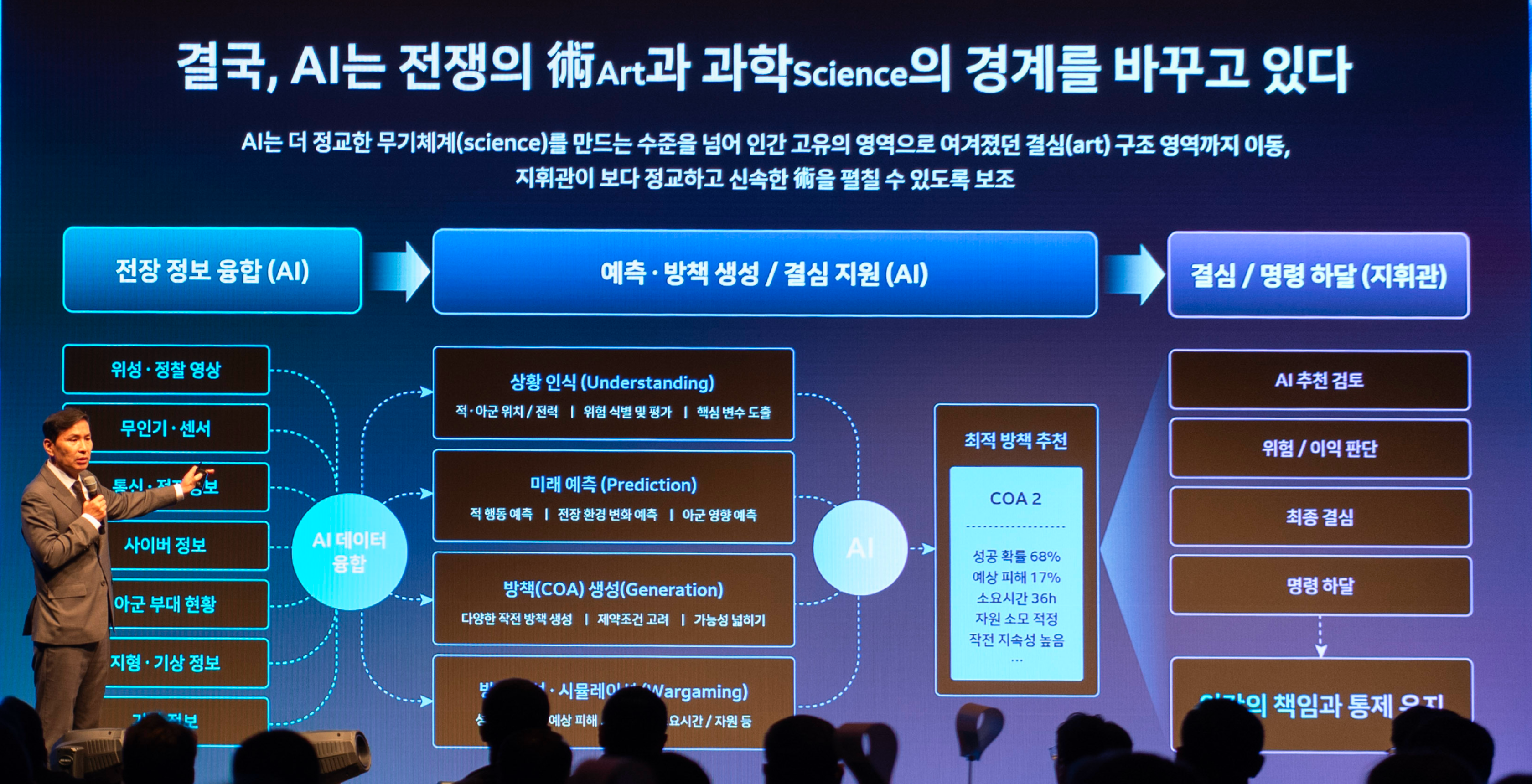
AI’s role has gone beyond making weapon systems more sophisticated. It’s moving into the structure of “decision-making,” long considered a uniquely human domain. It now fuses battlefield information, predicts outcomes, and generates courses of action so that commanders can judge faster and with greater precision. AI is redrawing the boundary between the art and the science of war.
2. Defense AX is no longer optional
Overcoming the uncertainty and complexity of the battlefield comes down to making commanders’ decisions faster and more accurate, so they can seize the initiative. That’s why defense AX has become a requirement rather than a choice.
AI strengthens every link in the chain from information to decision to victory.
- Overwhelming information superiority: real-time information fusion, courses of action generated from analysis and prediction, and simulation-based recommendations
- Decision support: connecting organized information to the commander’s decision, orders, and execution
- Maximized operational effect: a faster OODA loop (observe, orient, decide, act) and more accurate situational understanding and prediction
- Battlefield initiative: minimizing losses through optimal courses of action, and gaining a combat edge by deciding faster and more accurately than the adversary
Meanwhile, conditions are getting harder. The pool of 20-year-olds available for military service is projected to fall from 230,000 to around 140,000 by 2040, and threats across space, cyber, drones, and other domains are growing more complex.
3. The answer is an end-to-end civil-military ecosystem
Under these conditions, the most important factor for successful defense AX is building an end-to-end civil-military ecosystem: a structure in which, under a commercial-first principle, the private sector drives technological innovation and the military integrates it quickly.
What matters here is not stopping at trialing commercial technology, but going all the way to fielding and scaling it. Only when the pipeline from prototype through demonstration to fielding is complete does private-sector innovation translate into real military advantage.
This ecosystem rests on three pillars.
- A technology-centered acquisition system: an unbroken acquisition path from prototype adoption through demonstration to fielding
- More AI testbeds: more sites where technology can be validated in real units and in the field
- Civil-military talent integration: a structure in which AI specialists from the military and the private sector grow together
Defense AX is about effectively fusing AI with the military’s operational concepts, weapon systems, organization, and warfighters.
A changing battlefield: Proposals for accelerating sovereign AI for defense
Kebin | Executive Vice President and Head of Defense Business, NAVER Cloud
How can Korea accelerate sovereign AI for defense? This session examined the changing battlefield, the main bottlenecks holding back our military’s AI transformation, and what we need to prepare together to clear them. It then laid out a sovereign AI strategy and direction suited to Korea’s defense environment and capabilities.
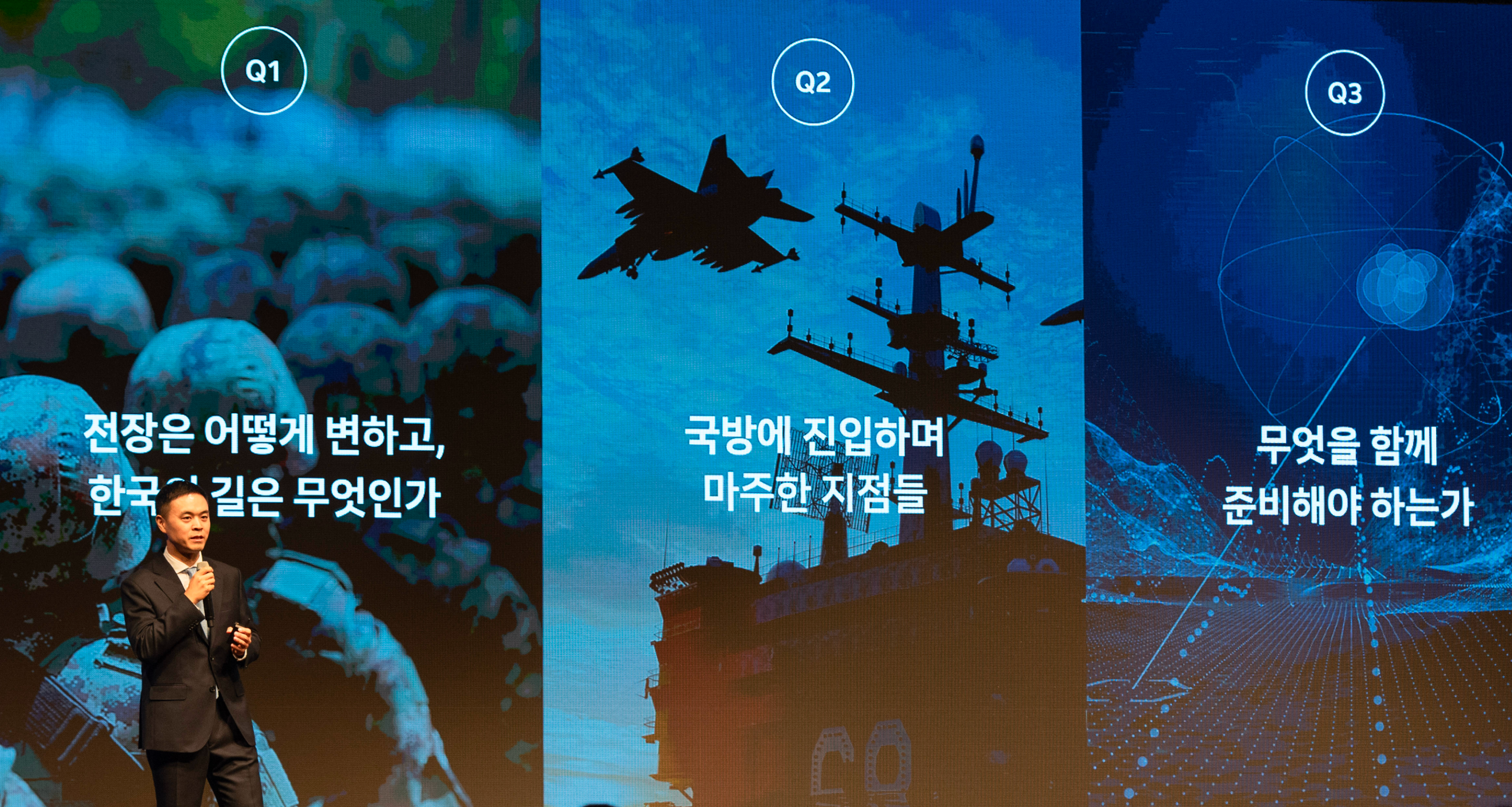
How is the battlefield changing, and where does Korea’s path lie?
AI is already changing the military’s decision cycle, its industrial ecosystem, and even how operational control works.
- A compressed decision cycle: real-time data linked directly to judgment and execution, changing the speed and unit of observation, decision, and action
- A shifting industrial ecosystem: AI companies emerging as key defense partners, and new technology reaching the force faster
- A new approach to control: a worldwide push to use commercial technology while keeping control over core operations
Korea’s conditions are different, though. We don’t have enough full-scale war data, a realistic validation environment is hard to reproduce, and the defense budget has its limits. Paradoxically, these constraints can be an opportunity to design a strategy that’s Korea’s own. Different conditions call for a different approach to acquiring data, validating systems, and fielding them. Every country is consolidating capabilities at the national level in its own way: the United States around a handful of companies, Europe through alliances between nations.
AI competitiveness doesn’t come from individual technologies alone. It depends on how effectively the relevant capabilities are pooled. Korea, too, needs a strategy that concentrates its limited capabilities on critical missions.
What’s holding back our military’s AI transformation?
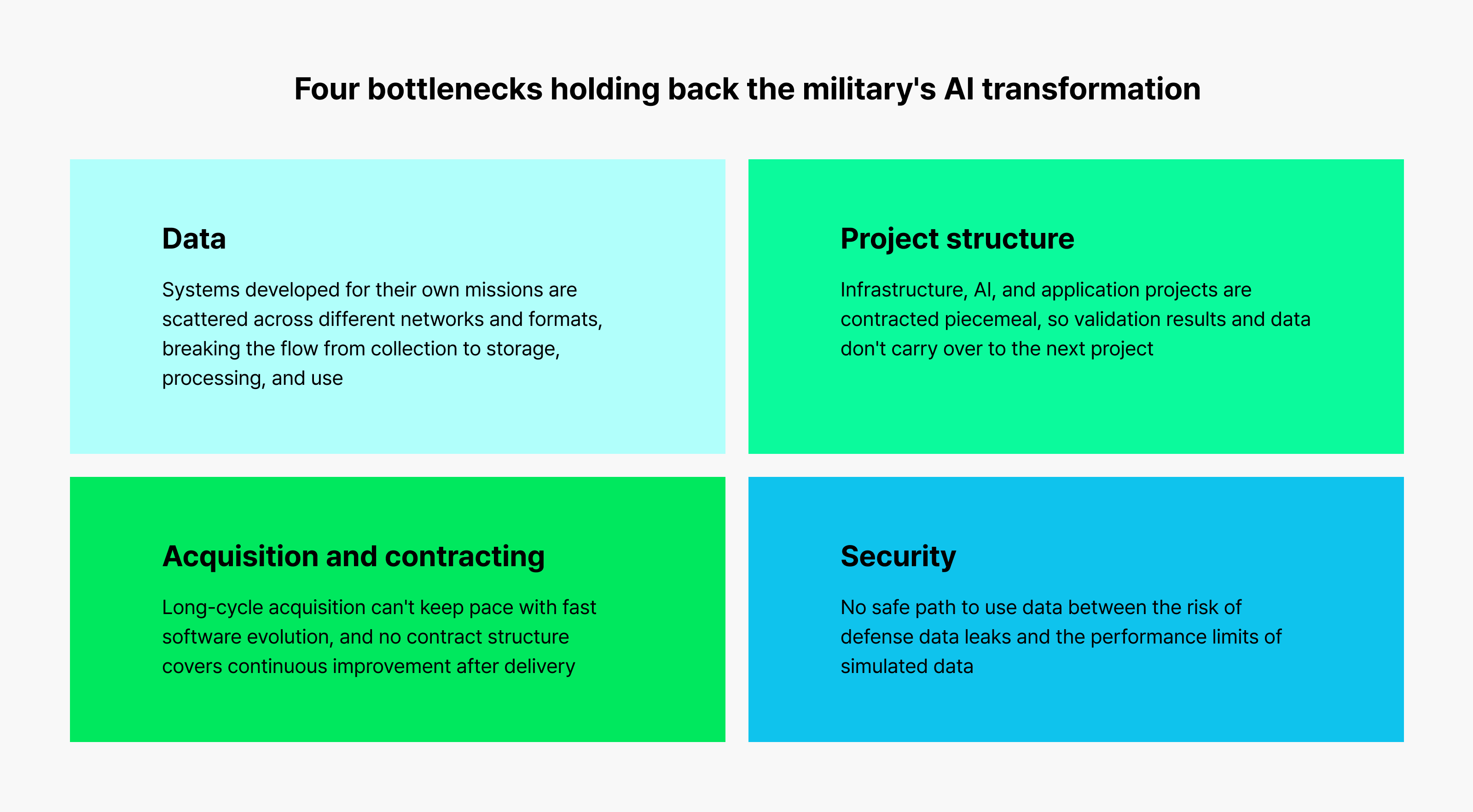
Seen from the viewpoint of a company newly entering the defense sector, the bottlenecks fall into four areas.
What do we need to prepare together?
Four principles for action address these bottlenecks: consolidate, deploy, validate, and evolve.
- Consolidate by role.
Instead of contracting infrastructure, AI, and applications in the same fragmented way, each player should focus on its strengths: big tech on the infrastructure and AI stack, startups on applications, and systems integrators on connecting to existing weapon systems and command-and-control systems. - Finish the job in the field.
Developing technology alone doesn’t create combat capability. Forward deployed engineers (FDEs) need to be stationed alongside the military, adapting technology to real missions and environments and filling gaps together. That’s how experience gained in the field turns into real capability. - Validate on two tracks.
Prove real results first in logistics, education and training, and administration, where operational data already exists. At the same time, validate the full stack by connecting infrastructure, data, model, and application end to end, even if the scope is narrow. - Evolve toward a subscription model.
The key is to move away from building a system once and delivering it, toward a subscription-style partnership in which forward deployed engineers stay on site and use, feedback, improvement, and updates run in a continuous cycle.
With these four principles in place, sovereign AI for defense becomes an evolving force.
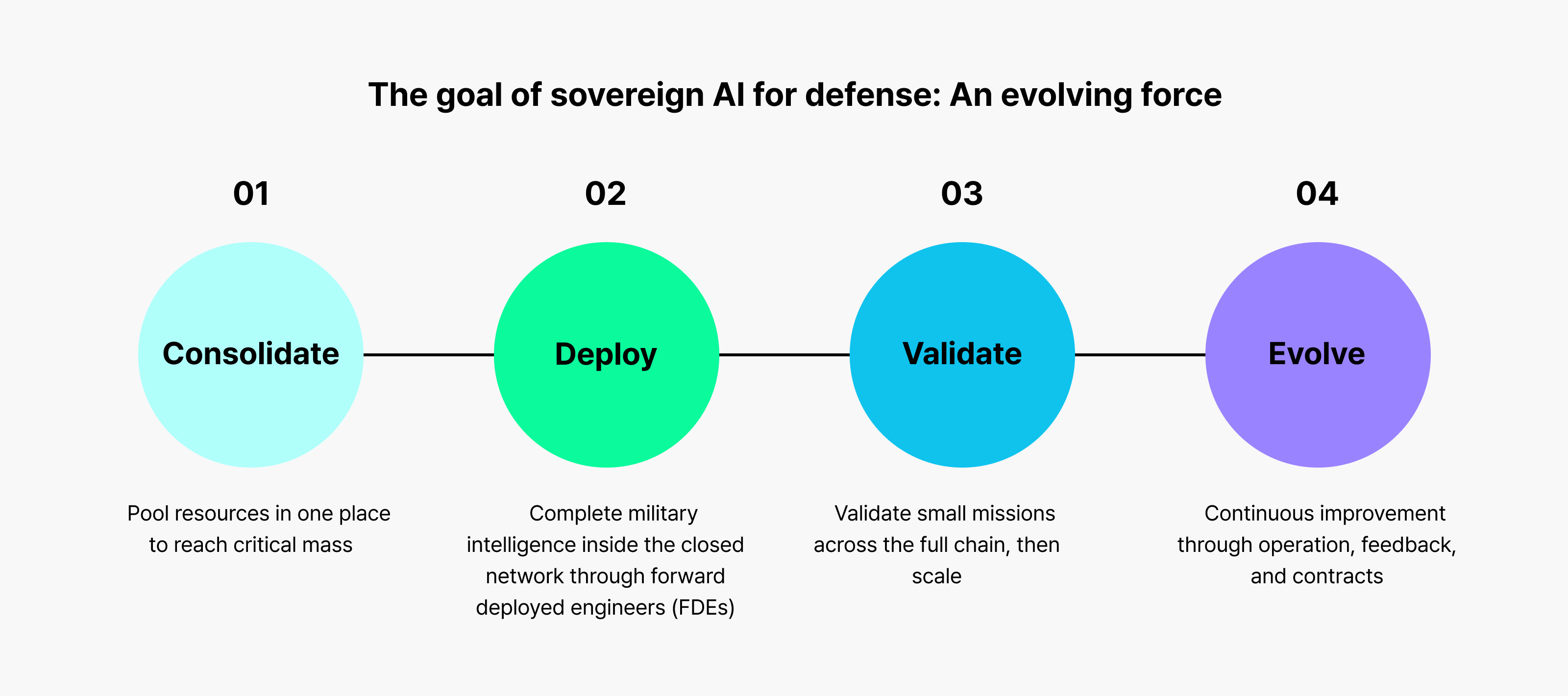
That means pooling capabilities by role, completing them in the field against real missions, and feeding operational experience and feedback back into improvement. Defense AI can’t end with a single build and delivery. When the military and industry accumulate experience together and keep improving, defense AI becomes a force that evolves on its own. And ultimately, the military must hold the initiative over the direction of that evolution and the choices it involves.
A strategy for intelligent autonomous weapon systems
Sung Nako | Executive Vice President and Head of Hyperscale AI Technology, NAVER Cloud
Making individual pieces of equipment smarter and designing the intelligence of an entire military are different problems. This session covered how to design defense intelligence in layers, and how to build the intelligence at each layer and deploy it in the force.
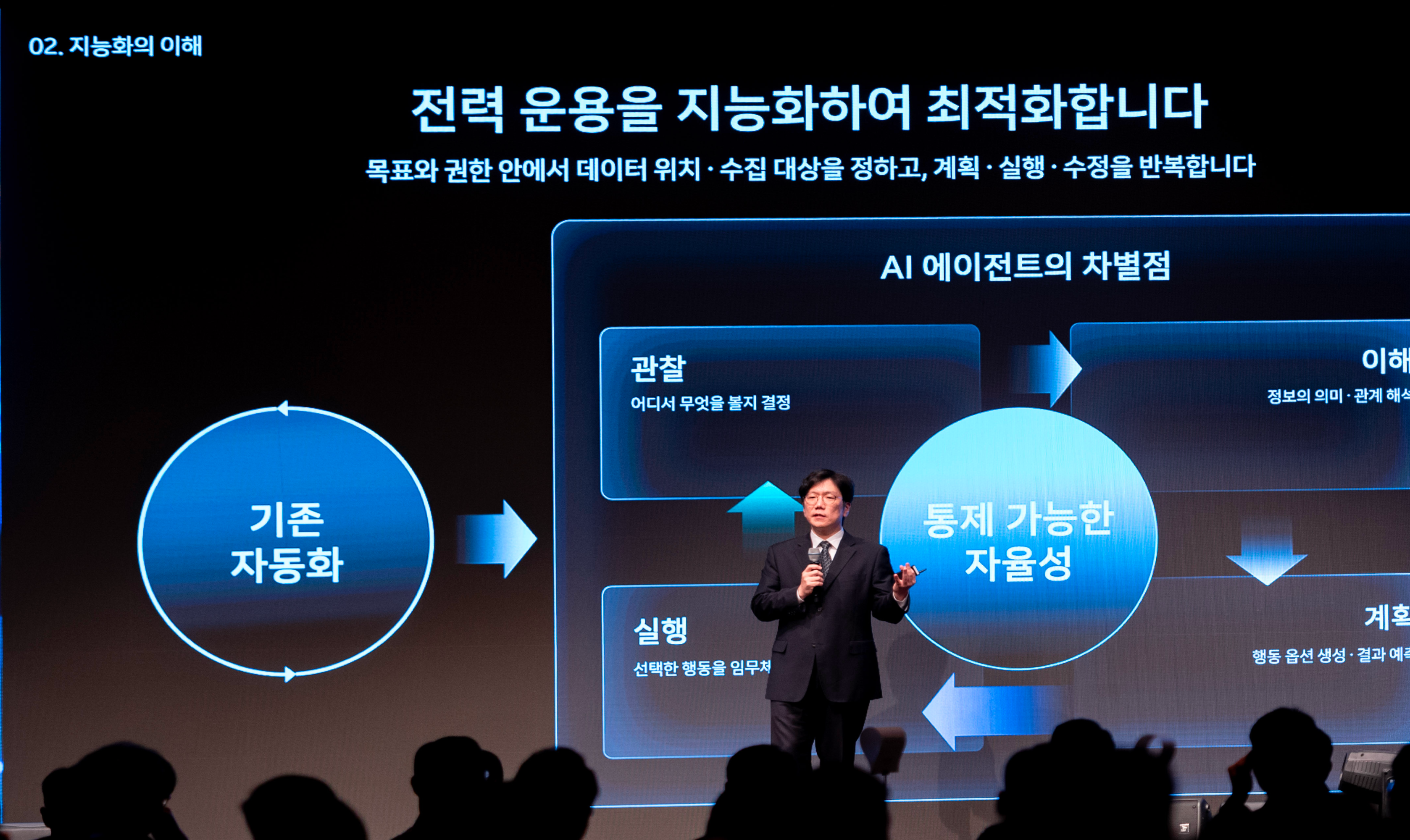
Each layer needs a different kind of intelligence
Conventional automation carried out fixed procedures. The intelligence AI brings is different: it can autonomously revise the procedures themselves.
The military’s decision-making structure is multilayered. Information from the field is compressed as it moves up, and higher echelons judge on that basis and send commands back down. Within a force network, multiple intelligences with different missions and time constraints coexist.
- Central: intelligence that handles long-term patterns, policy, and large-scale training
- Operational hubs: intelligence that judges an already-condensed picture in minutes or hours
- Tactical edge: intelligence that integrates the surrounding state and coordinates collaboration among multiple assets
- Endpoints and platforms: small, specialized intelligence that processes large volumes of raw observations instantly
The lower layers need to reduce large volumes of information quickly, and the higher layers need to judge that condensed information more broadly and deeply. Since each layer needs a different kind of intelligence, a hybrid deployment of multiple models matched to each layer suits defense better than a single giant model.
Intelligence has to evolve on its own
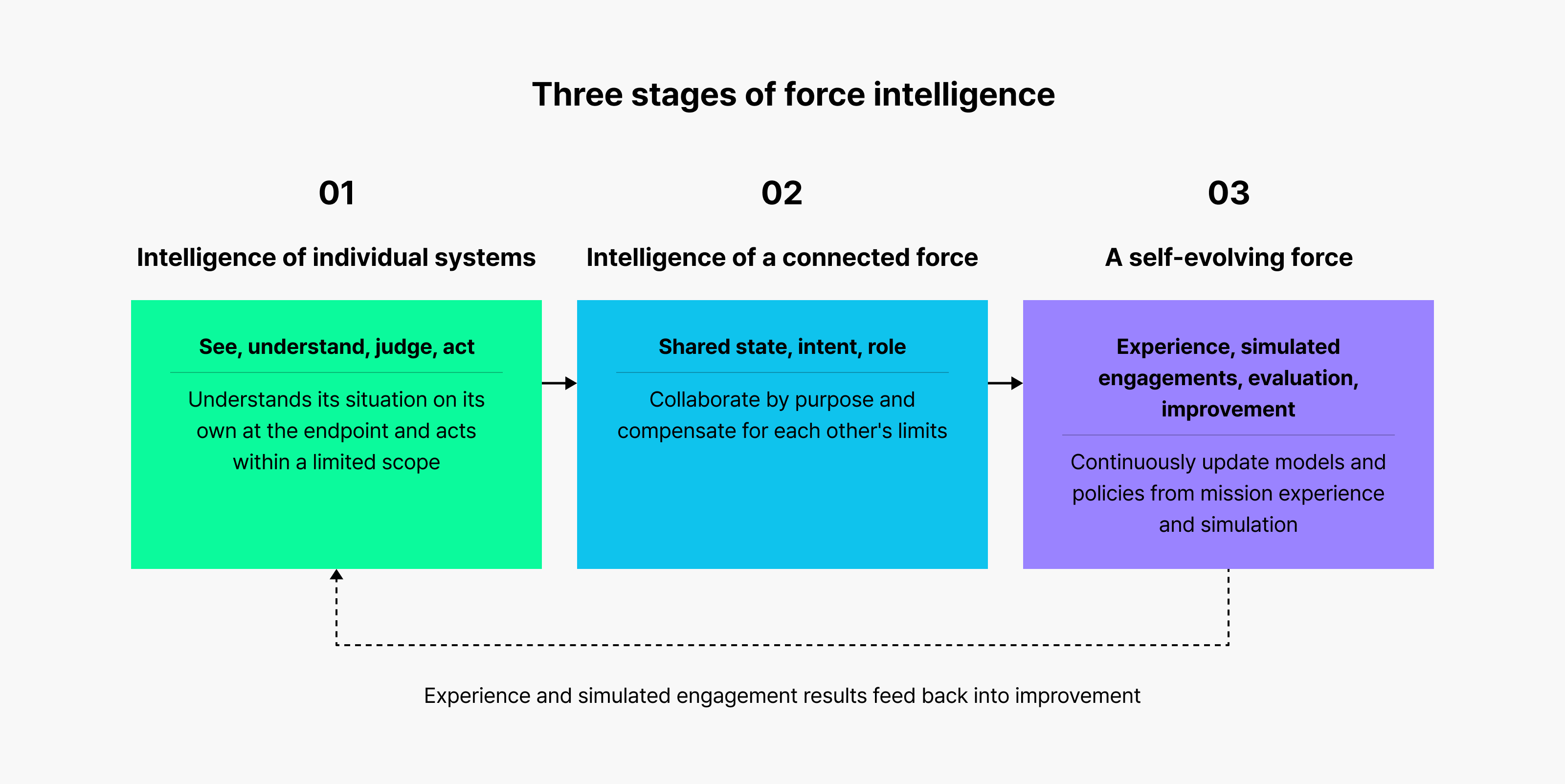
Defense AI is moving beyond automating individual functions toward collecting, processing, and sharing the information it needs and connecting that to judgment and action.
- Intelligence of individual systems: a single system perceives and judges its situation on its own
- Intelligence of a connected force: multiple systems collaborate by purpose and function as one force
- A self-evolving force: mission experience feeds back into improving models and policy
As these three stages fall into place one by one, they together form an intelligence network that runs from individual systems up to the whole force.
A shared semantic framework for a single battlefield
For many intelligent components to exchange information, one thing is indispensable: a shared semantic frameworkthat lets different systems understand the same object in the same way. Information observed by different platforms, such as drones, ground assets, sensors, and maps, has to be interpreted as the same state, intent, and role before those platforms can move as one force.
An intelligent force isn’t complete with a network that merely passes data around. It has to be an intelligence network in which different systems share an understanding of what the data means and act on it.
How do we build intelligence that’s ready for defense?
Building intelligence for the military runs into two practical challenges.
- Closed networks: military data contains sensitive information and can only be handled inside closed networks.
- Compute: scaling up the size and performance of intelligence takes correspondingly large GPU resources.
A new approach to both is to train first in an open environment and bring in classified data only at the final stage, inside the closed network.
- Commercial hyperscale: large-scale pretraining of language, reasoning, and multimodal capabilities
- Defense-adjacent domains: narrowing the gap to defense with public, unclassified data from aviation, maritime, land, cyber, and other domains
- Adaptation checkpoint: securing a model state adapted for defense use, along with the training tools and evaluation criteria
- Focused training in the closed network: moving only the checkpoint into the closed network and completing final training on internal data
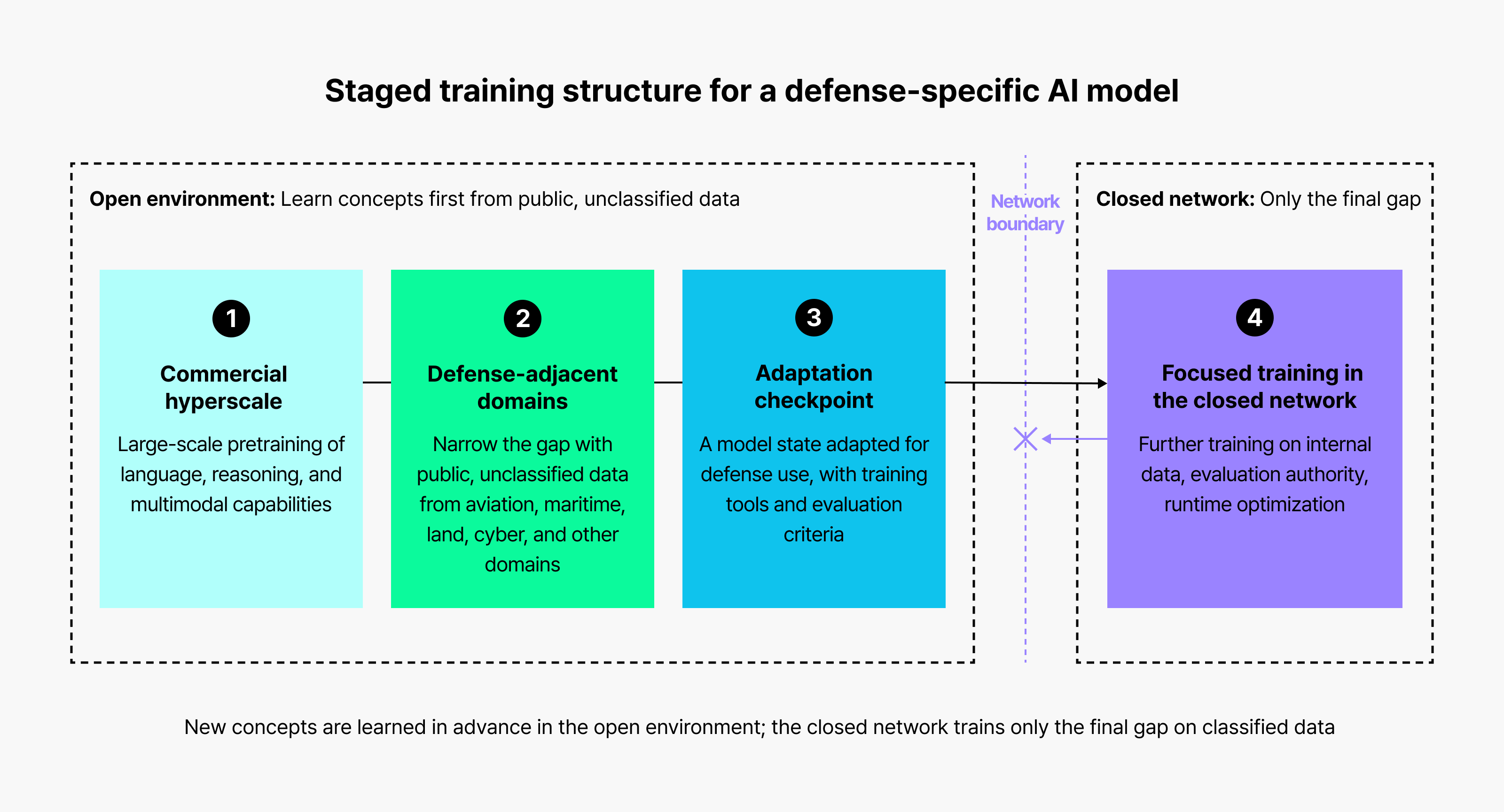
Throughout this process, classified data never leaves the closed network. Only the pretrained model moves in. So to build a specialized model for the military, the starting-point model has to be prepared in a domain as close to the defense domain as possible, with sufficient resources.
The key is securing an AI model partner that can keep supplying a defense-ready starting point. Rather than looking only at a model’s current performance, the question is whether the partner can also provide the training capability and technical foundation that keep moving the model closer to the defense environment. The closer the starting point is to the defense domain, the less additional training cost and data the closed network requires, the faster it adapts to new environments, and the easier it is to swap models.
Making autonomous weapon systems intelligent is a process of connecting the entire force into a single intelligence network, enabling its parts to communicate in shared terms, and growing that intelligence safely from a defense-ready starting point. And for each stage of that process to connect seamlessly, the military needs an AI model partner it can grow with over the long term.
Ontology-based real-time defense data for command decision support
Lee Soeun | Director, Defense AI Platform
Does more data mean a better understanding of the battlefield? This session looked at how defense data needs to be connected and structured to genuinely support commanders’ decisions, and at the technical stages of the NAVER Cloud defense AI platform built to do that.
Battlefield initiative comes from speed of understanding, not volume of information
As surveillance assets and C4I systems* expand, the volume of information flowing into command posts keeps growing. But the more information there is, the more time it takes to cross-check it, confirm its context, and interpret what it means. As long as data is scattered across different formats and contexts, more of it doesn’t translate into faster decisions. Most of the time between information and a commander’s decision goes not to the information itself but to the work of understanding it.
* C4I: the military command system that integrates command, control, communications, computers, and intelligence
Two bottlenecks slow this down.
- Scattered information: C4I, surveillance assets, regulations, and field manuals fragmented across different systems and networks
- Repeated interpretation: even connected information has to be found, cross-checked, compared, interpreted, and compiled into briefing materials by staff officers by hand
As the U.S. Department of Defense’s JADC2* and GIDE* show, the crux of defense AI isn’t just better models. It’s building the data foundation AI can draw on first. Before adopting models, successful defense AI requires connecting data and structuring the relationships and context between them.
* JADC2: the U.S. military’s concept for integrated command and control connecting all operational domains
* GIDE: a U.S. military experiment that validated rapid decision-making based on connected data
Three technology stages of the NAVER Cloud defense AI platform for command decision support
To understand the battlefield quickly and connect that understanding to the commander’s judgment, three stages have to run as a single flow: (1) connecting data, (2) structuring meaning, and (3) analyzing and comparing courses of action.
- Data fabric: connects heterogeneous defense data in real time in a structure AI can use
- Defense ontology: structures the meaning, relationships, and doctrine behind the data
- AI decision agent: compares multiple courses of action through analysis and reasoning
1. Data fabric: Connecting the battlefield
Connecting defense data means dealing with several constraints at once.
- Siloed structures: data fragmented across systems and networks because each department and agency operates independently
- Mixed protocols: everything from legacy C4I to modern APIs
- Separated networks: operational, administrative, and surveillance-reconnaissance networks kept strictly apart for security
- No downtime: existing systems running around the clock have to be integrated without interruption
- Large-scale real-time processing: massive data streaming in from drones, satellites, and sensors has to be handled without delay
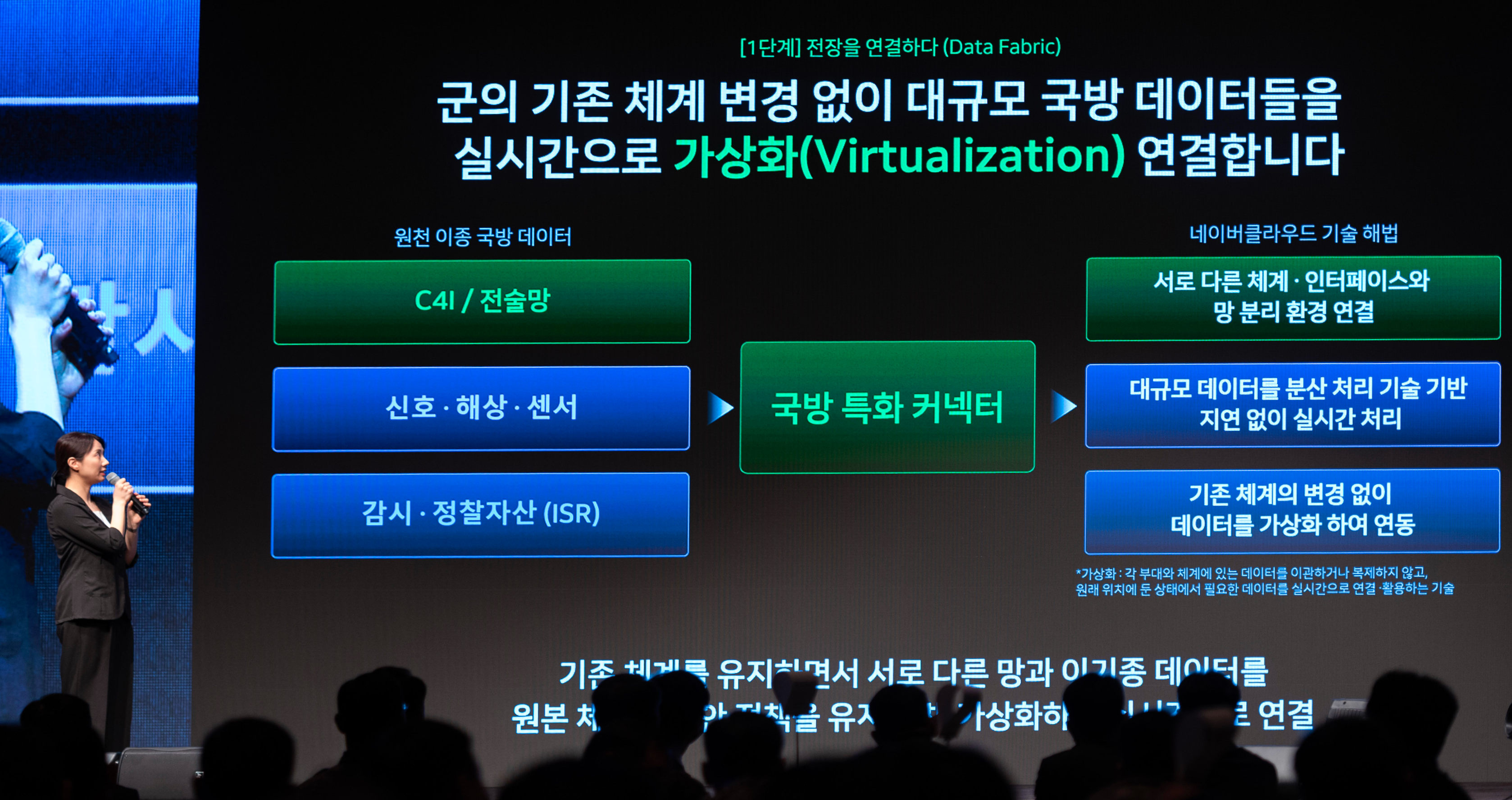
NAVER Cloud addresses these with defense-specific connectors for integrating heterogeneous systems across separated networks, large-scale real-time data processing, and virtualization.
Virtualization in particular leaves data where it is, without migrating or copying it, and connects to it in real time while preserving the source system’s security policies. Data scattered across different systems can be connected without major changes to those systems.
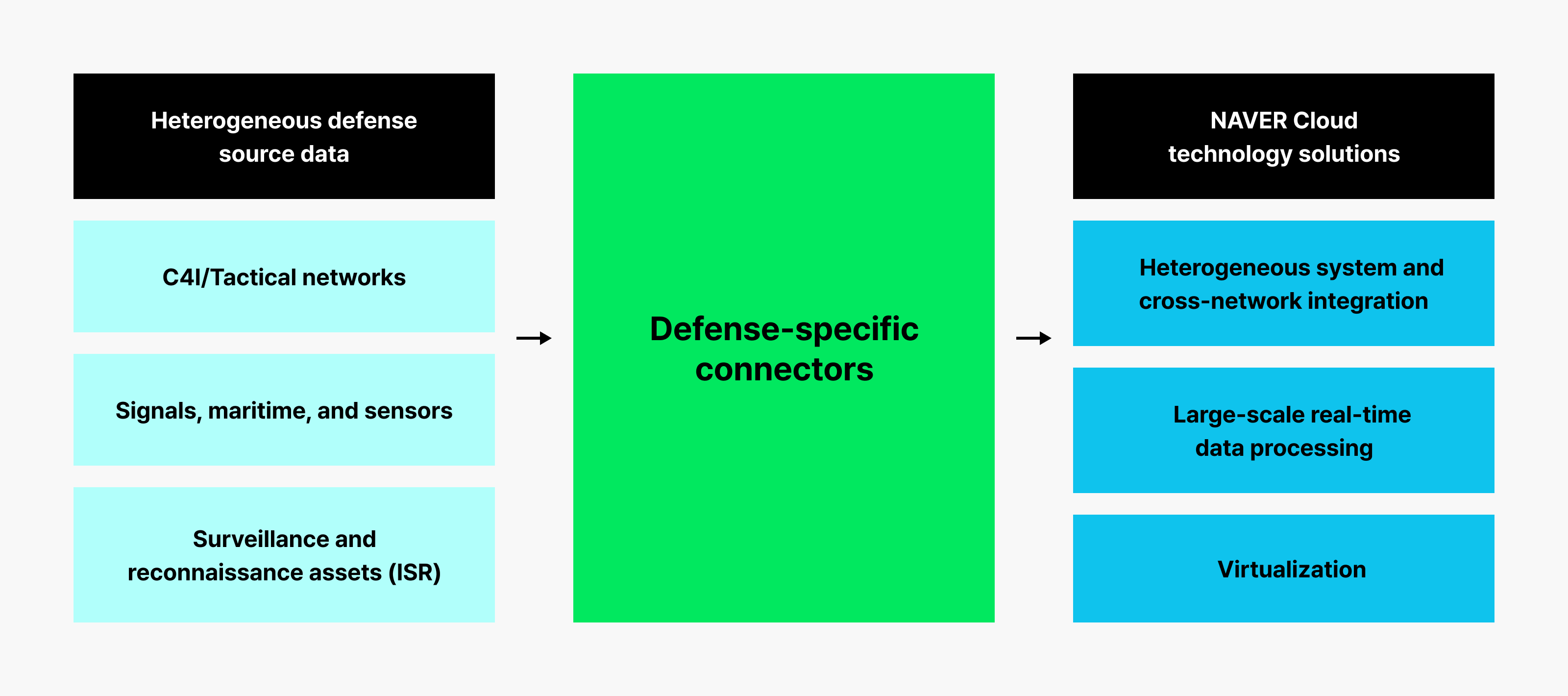
Connecting isn’t enough on its own, though. Data in varying formats and structures also has to be refined into a form defense ontology can use downstream. Data fabric connects scattered heterogeneous data in real time while leaving existing systems intact, and builds the data foundation AI can work from.
2. Defense ontology: Understanding the battlefield
Connected data doesn’t automatically add up to an understanding of the battlefield. Individual data points such as unit movements, sensor detections, and weather changes may all exist, but unless the meaning and relationships between them are understood, AI struggles to grasp battlefield context too. That’s the job of defense ontology.
Defense ontology is a body of defense knowledge that structures the concepts, relationships, and doctrine the military needs to understand and judge the battlefield.
For example, when an enemy tank unit is detected on the move, defense ontology goes beyond the bare fact that “tanks moved” and links it to its meaning and the surrounding situation.
- What is there → forward movement of tanks in the deep area
- What it means → indication of attack and offensive maneuver
- What it connects to → movement routes, likely breakthrough areas, and friendly defensive lines
- What it means doctrinally → links to decisions on forward reinforcement and counterstrike
- What can be inferred → counterstrike feasibility and analysis of response options
Structuring data so that it’s linked to meaning, relationships, and doctrinal context also changes how staff officers work.
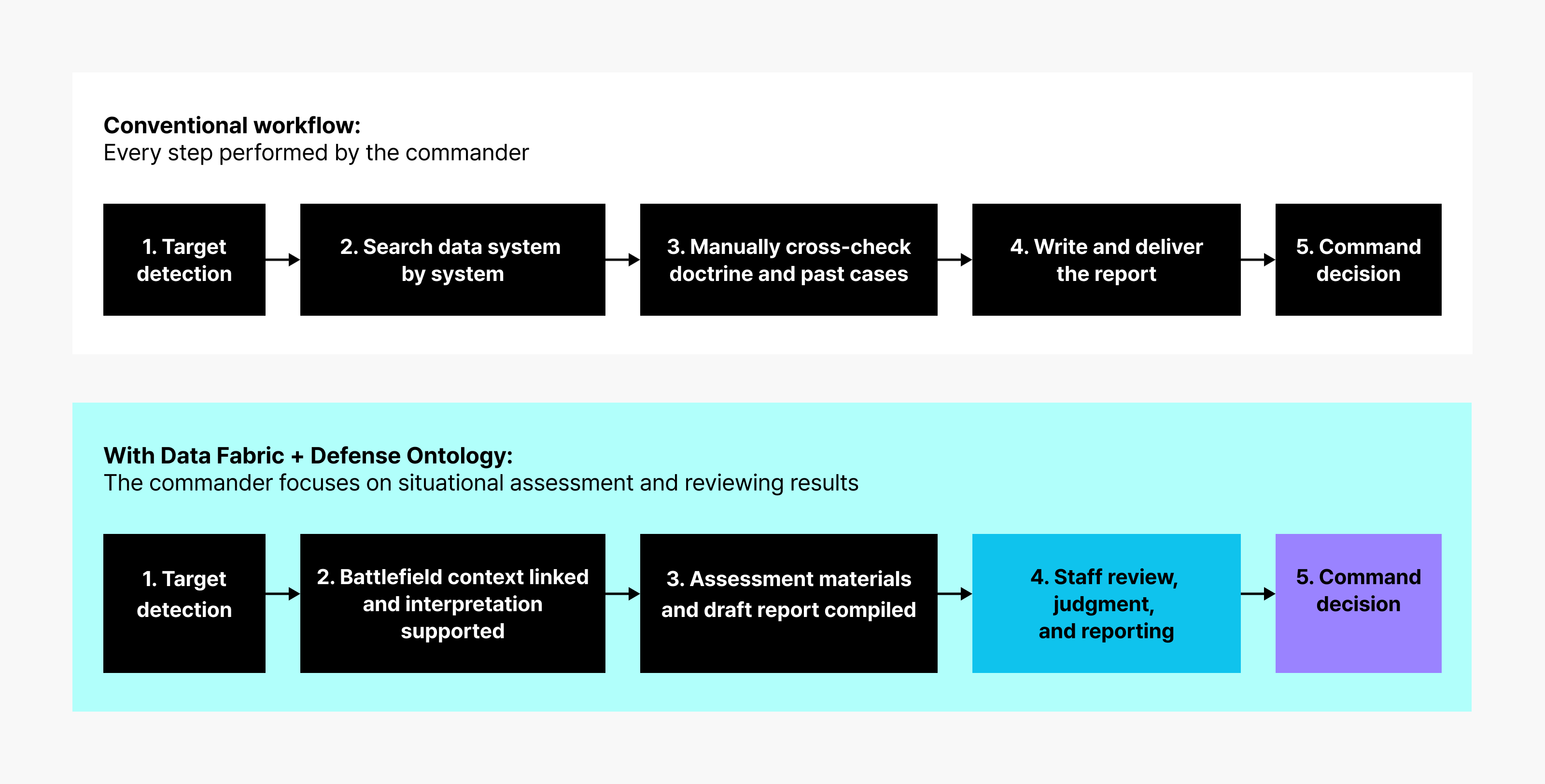
It cuts the time spent on repetitive searching and cross-checking, so staff can focus on assessing the situation and reviewing results. Commanders grasp the information they need faster, and the time to decision shrinks. Defense ontology turns the way the military understands and judges the battlefield into a knowledge structure AI can use.
3. AI decision agent: Supporting the decision
Building defense AI means connecting scattered data, understanding its relationships and context, and turning it into the information commanders need, all in one continuous flow. Data fabric and defense ontology aren’t build-once technologies. As new data arrives and the battlefield environment and operating systems change, they have to keep connecting and understanding it. A defense AI platform therefore needs a foundation that continuously reflects changing data and knowledge while running reliably around the clock, every day of the year.
Drawing on our experience in large-scale data processing and platform operations, NAVER Cloud provides a defense AI platform that supports stable deployment and continuous operation in defense environments. We also enable solutions from commercial AI startups to plug into the platform, so new technology can connect flexibly to the field and grow alongside it.
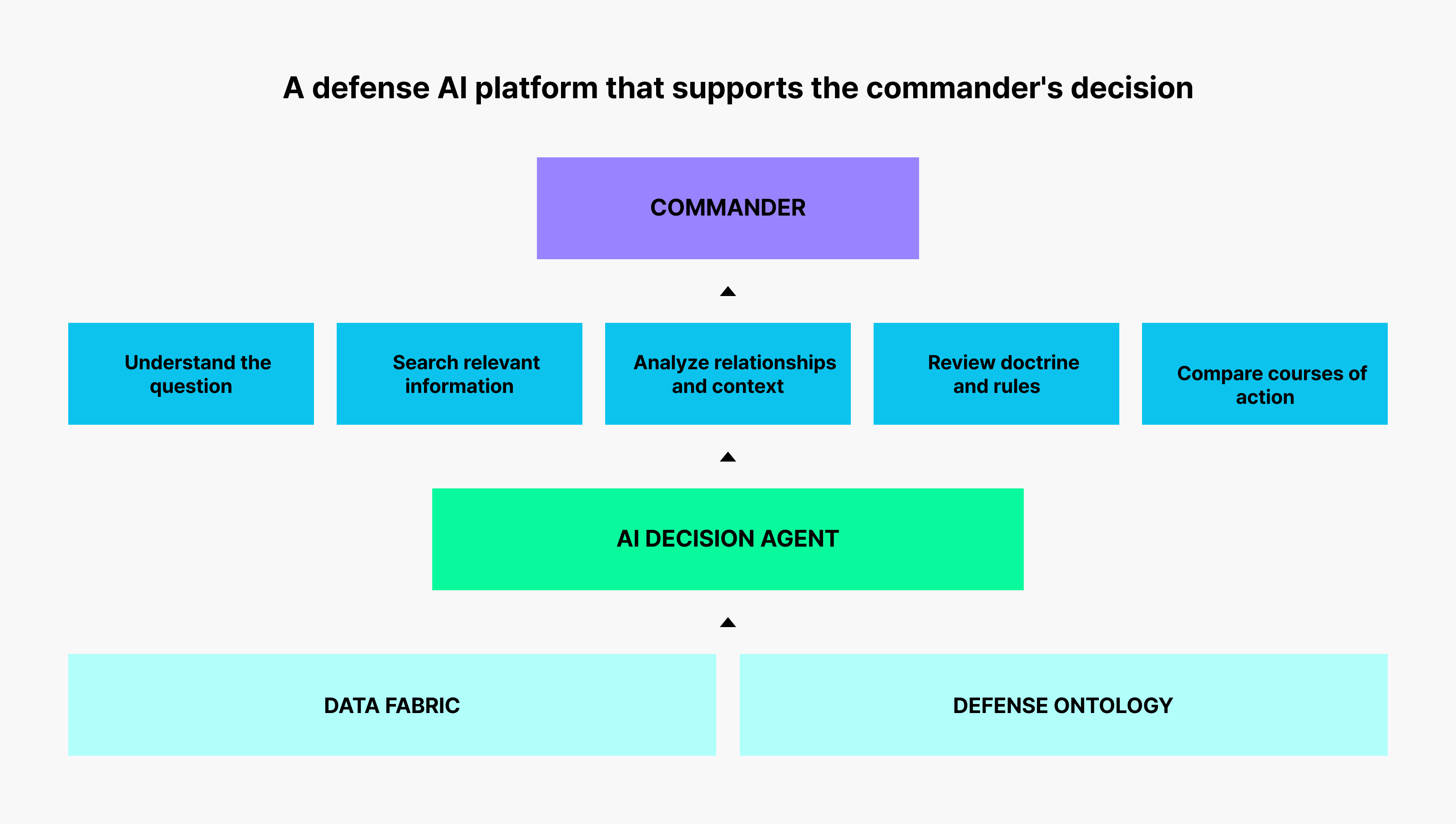
But however far defense AI advances, it can’t take over the final judgment. Amid vast information and complex situations, the commander’s judgment in giving the final order always carries grave weight. AI’s role isn’t to decide in the commander’s place. It’s to connect data quickly and help make sense of its meaning and context, creating an environment where commanders can judge faster and more accurately.
NAVER Cloud aims to be the trusted technology partner that keeps data, knowledge, and AI evolving to back commanders’ judgment, even as the defense environment changes.
A defense-specific cloud strategy that protects control over AI and data
Park Jong Gun | Director, Defense Frontier
As AI goes deeper into military missions, what must infrastructure protect? This session looked at how infrastructure needs to change to run AI reliably, and what control the military must secure and keep along the way.
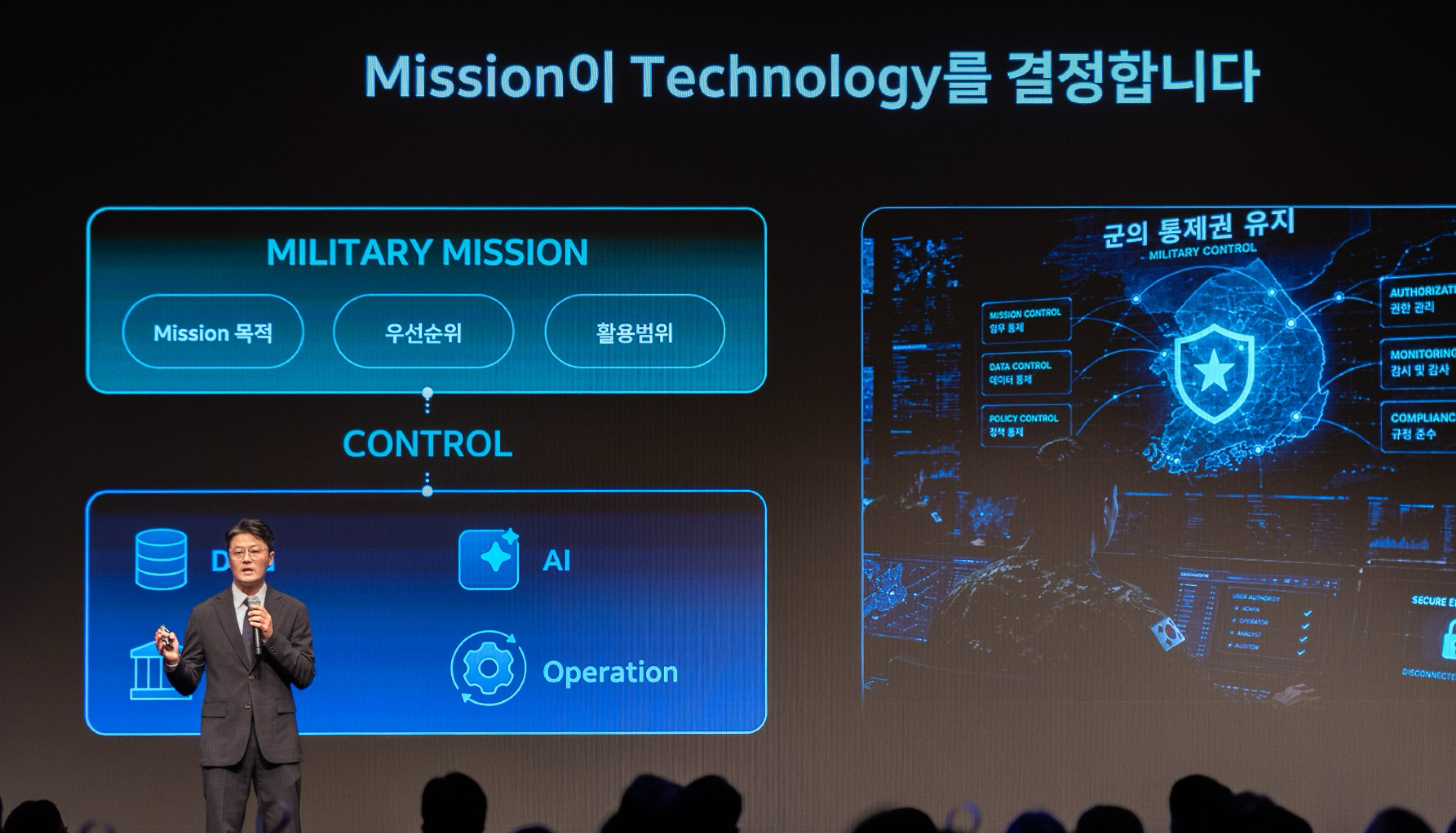
Why does defense need new AI infrastructure?
AI infrastructure is often thought of as a question of how many GPUs you can secure. But as AI is adopted, the role of infrastructure itself is changing. The whole cycle has to run continuously on top of it: collecting and refining large-scale data, training and validating models, deploying them to real missions and operating them, and feeding field feedback back into improvement. The heart of AI infrastructure isn’t raw compute but the ability to keep executing and evolving this entire lifecycle.
The catch is that the closer AI gets to real missions, the more the demands on infrastructure change.
- Central: where AI models shared across the armed forces are trained and large-scale data is processed
- Mission hubs: forward sites supporting specific missions such as ISR*, training, and analysis
- Tactical field: where command decisions and tactical judgments are made alongside sensors, unmanned aircraft, vehicles, and robots
* ISR: the military term for intelligence, surveillance, and reconnaissance activities
As AI moves closer to the mission, it’s not just the location of computing that has to change. The way things connect, the way they’re operated, and the way data and AI are controlled all have to change with it. That’s why defense AI needs new infrastructure.
Redesigning commercial technology for defense
Building new AI infrastructure doesn’t mean separating defense from commercial technological progress. On the contrary, the right approach is to use fast-moving commercial cloud technology and redesign it for defense security, control, and operating conditions. Conventional IT infrastructure kept infrastructure and data apart, and building and deploying it took a long time, which limited how quickly advancing AI could reach the field. Now the goal is to harness the pace of commercial innovation while also meeting defense’s particular conditions, such as distributed operating environments and joint and combined operations.
The U.S. military’s use of the cloud points the same way. Security levels are tiered by the importance of the mission and the data, and commercial cloud capabilities are configured into environments that meet defense requirements. JWCC* is another example of this approach to continuously drawing on rapidly advancing commercial cloud technology for defense.
* JWCC: the U.S. Department of Defense’s cloud acquisition vehicle, which contracts with multiple commercial cloud providers
- The core of defense AI infrastructure: commercial innovation + defense requirements
The key is not to choose between commercial innovation and defense control. It’s to use commercial innovation and layer defense security, control, and operational requirements on top.
Two things infrastructure design has to put first
Performance isn’t what matters most when designing new defense AI infrastructure. The point is to build a structure that lets the military choose and control its missions, rather than one where technology takes them over. That calls for two principles.
First, control.
The military must be able to decide how AI is applied and changed, and which version is used. It needs a structure with clear military control over security, permissions, and approvals; the scope of data access, storage, and movement; and responsibility for operations and audit.
Second, mission continuity.
Defense environments can’t guarantee a stable network. Connectivity may be smooth, bandwidth may be limited, or the link may drop entirely. Whatever the network conditions, the AI and data a mission depends on have to keep working.
- CONTINUE: Never stop the mission
Approved AI services and the data and operational functions the mission needs keep running, within the scope the mission requires, even as connectivity changes. - EVOLVE: Never stop the AI
Models, data, and software keep advancing, but they evolve safely through military validation and approval rather than automatic updates.
The essence of defense AI infrastructure is that the mission continues even when the connection drops, and AI evolves in a controlled way even as the environment changes. Infrastructure that makes an uninterrupted mission and controlled evolution possible at the same time: that’s the standard defense AI infrastructure has to meet.
Defense-specific cloud: An integrated foundation, flexible operations
The defense-specific cloud is the offering that puts these design principles into practice. It connects the execution foundation defense AI needs, including AI, data, cloud, and GPUs, into a single structure, and builds defense requirements such as security, disconnected operation, mission control, and operations on top. On that integrated foundation, actual deployments can be configured flexibly to fit the mission and the procurement conditions.
The defense-specific cloud can also be deployed in three forms, depending on location, mission, and the level of independent operation required.
- Central integrated: consolidates large-scale AI, data, and GPU resources for large-model training and shared AI services
- Mission hub: runs the AI and data functions each service branch or operation needs at its own site, with a degree of independence even when the link to the center is limited
- Field operational: a lightweight AI environment that subordinate units can use immediately, sized to their installation space and operating conditions
Infrastructure configured this way has to keep the mission going even when connectivity is lost. While the center and the field are connected, models and policies are synchronized. When the link drops, the field operates independently. When it’s restored, only the necessary changes are applied, in a controlled way.
- Connected: the center deploys and synchronizes validated models, services, and policies
- Disconnected: the field operates independently on approved models and local data
- Reconnected: only the necessary changes are synchronized selectively through the approval process, rather than overwriting field information wholesale
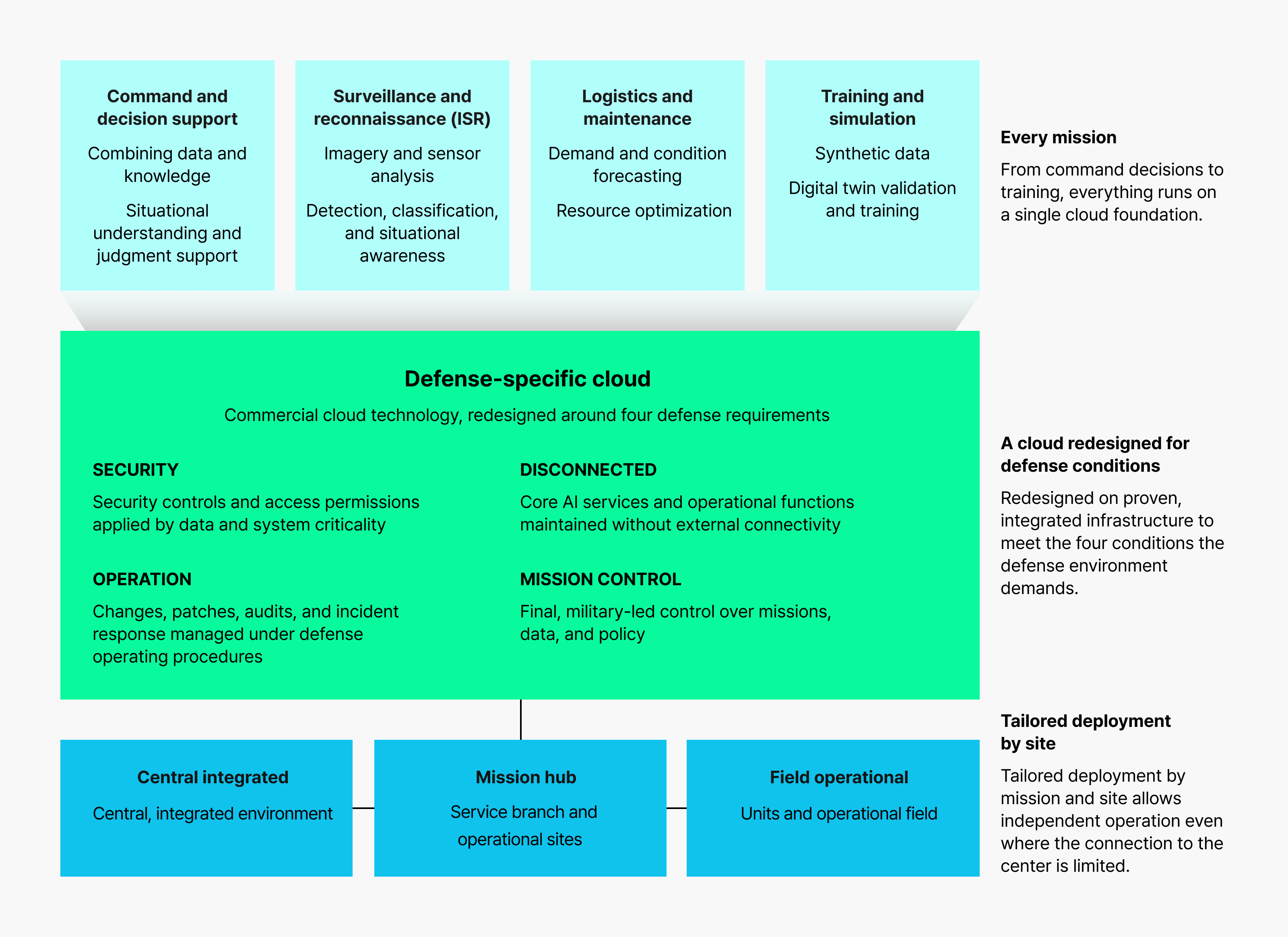
The defense-specific cloud is a common execution foundation that keeps drawing on fast-moving commercial AI and cloud technology while the military retains control, and keeps the mission going as connectivity changes. AI technology will keep changing quickly. Models and GPUs will change, and so will the ways AI is used. That’s why what matters is not delivering any single technology fixed in place, but a foundation that continuously connects changing technology to the military’s missions and control environment, and evolves with it.
The five sessions started from different topics but converged on a single question: in an era of rapidly advancing AI, what does the military need to prepare?
The answer isn’t simply securing better AI. It lies in putting defense data to use, developing AI to fit the defense environment, and building a foundation that can run it reliably anywhere. And at the center of all of it, the military has to keep the initiative over its technology and data.
Defense AI isn’t complete with any single technology. AI has to support judgment on a foundation of connected data and battlefield understanding, with infrastructure that can bring it into real missions. It also needs a continuous structure in which field experience feeds back into advancing AI and the force. NAVER Cloud aims to build that foundation together with the military, as a technology partner supporting the AI transformation of Korea’s defense.
Stay tuned as NAVER Cloud continues its work toward sovereign AI for defense.