
CHI 2026 Paper
Kim Young-Ho, Leader (HCI Research, NAVER AI Lab)
This post introduces a paper by NAVER Cloud that will be presented at ACM CHI 2026, the leading international conference on Human-Computer Interaction (HCI), taking place this April in Barcelona, Spain.
Autiverse: Eliciting Autistic Adolescents’ Daily Narratives through AI-guided Multimodal Journaling
Yang Migyeong (NAVER AI Lab)
Lee Kyungah (Dodakim Child Development Center)
Han Jinyoung (Sungkyunkwan University)
Park SoHyun (NAVER Cloud, NAVER AI Lab)
Kim Young-Ho (NAVER AI Lab)
ACM CHI 2026
Why autistic adolescents struggle to narrate their experiences
For an adolescent on the autism spectrum, a simple question like “What happened at school today?” can be surprisingly difficult to answer. They need to choose which events from the day are worth mentioning, put them in chronological order, and express the emotions they felt along the way.
These challenges aren’t just about communication—they can lead to real problems in daily life. Adolescence is a time of expanding peer relationships and navigating a variety of social situations. Autistic adolescents face the same kinds of difficult moments, from conflicts with friends to interactions with teachers. For parents and therapists to step in with the right support, understanding exactly what happened to the child is essential. They need the full picture—what caused a conflict with a friend, or what led to being scolded by a teacher—to offer appropriate guidance.
Yet many autistic adolescents struggle to organize their experiences into a coherent story. Because they often leave out important context, parents are left piecing together the situation from scattered clues.
Journaling as a tool for describing situations—and the barriers it poses for autistic adolescents
Journaling is one of the most widely used methods for organizing personal experiences. Regular journaling has long been recognized as an effective way to build self-understanding and develop narrative skills. But for autistic adolescents, traditional journaling can present yet another barrier.
The limits of text-based writing and the burden of open-ended questions
Journals are primarily designed for text-based writing. But many autistic individuals are strong visual thinkers, which makes organizing narratives through text alone a challenge. Most journals also start with an open-ended question like “Write about what happened today.” These kinds of prompts place a significant cognitive burden on autistic adolescents, who have to decide what to write, where to start, and how to express it.
How might we help autistic adolescents journal more effectively? This question was the starting point for Autiverse, an AI-powered tablet application.
Autiverse: Creating four-panel comic journals with AI
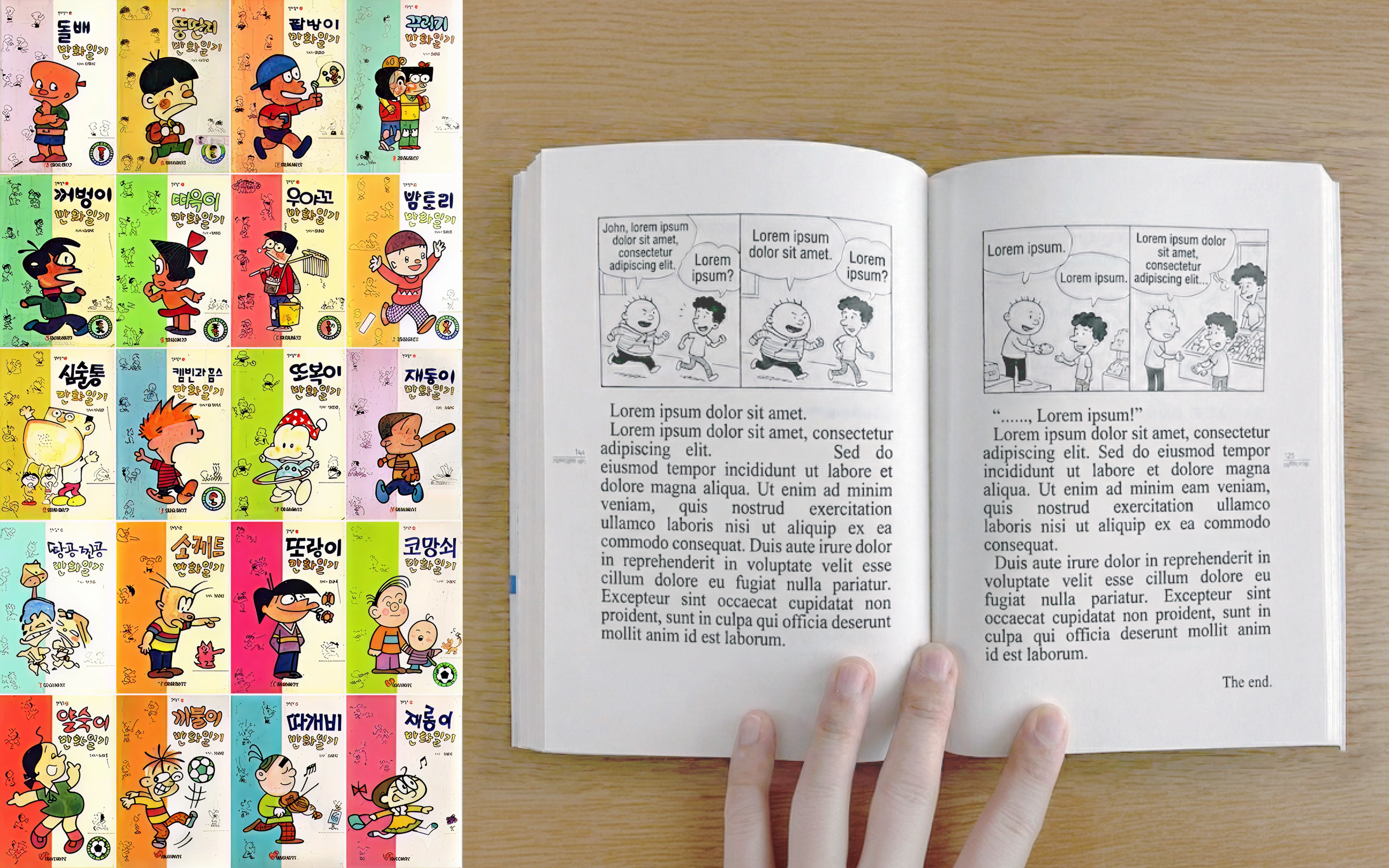
The Daekyo Publishing Comic Diary series (source: Namu Wiki), A Comic Diary entry reimagined with AI
If you grew up in Korea in the 1990s, you may remember the beloved Comic Diary series published by Daekyo. It featured short comic strips paired with brief diary entries. We drew inspiration from this format, believing that a comic-style journal would tap into the strong visual thinking abilities of autistic individuals.
What format should the comic journal follow? We adopted the ABC model, a framework used by behavioral therapists to understand problem behaviors. The model breaks down a situation into the context in which the event began (Antecedent), what happened (Behavior), and the outcome (Consequence). We added a fourth element—Emotion—to create the A-B-C-E four-panel comic structure. This framework helps children naturally organize their daily experiences into a coherent narrative.
The AI then asks step-by-step questions following this structure, drawing out the child’s story across all four components. By replacing open-ended prompts with structured conversation, it reduces the burden of figuring out what to say, where to start, and how to say it—while ensuring that no important context is left out.
Eliciting narratives through step-by-step dialogue
The AI in Autiverse isn’t a conversational chatbot like ChatGPT. Instead, it’s designed to guide the child’s experiences into a structured narrative through a step-by-step process.
The journaling process follows these steps:
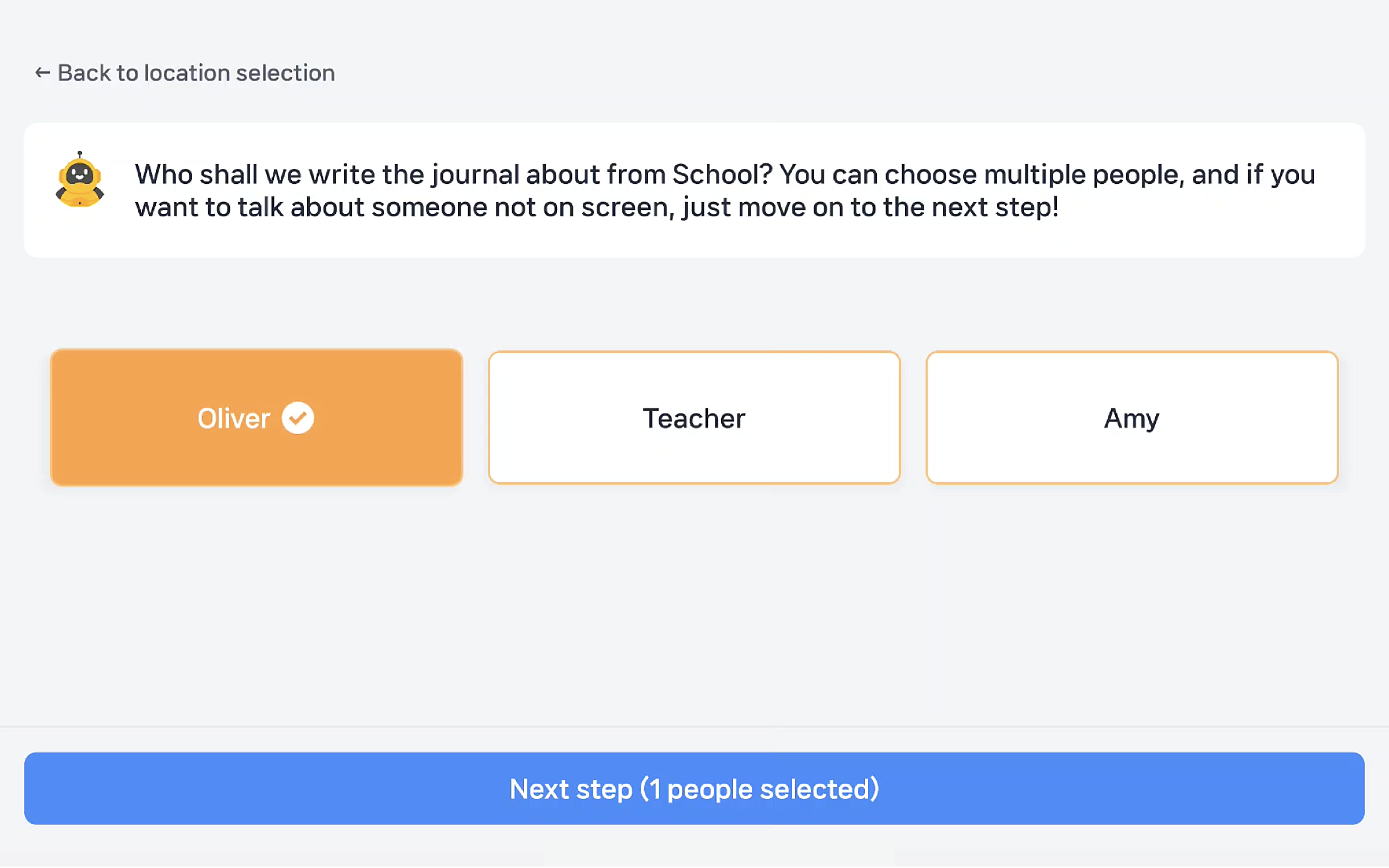
1. Preparation: The child starts by selecting a place and the people involved. These choices serve as cues to help trigger memory recall.
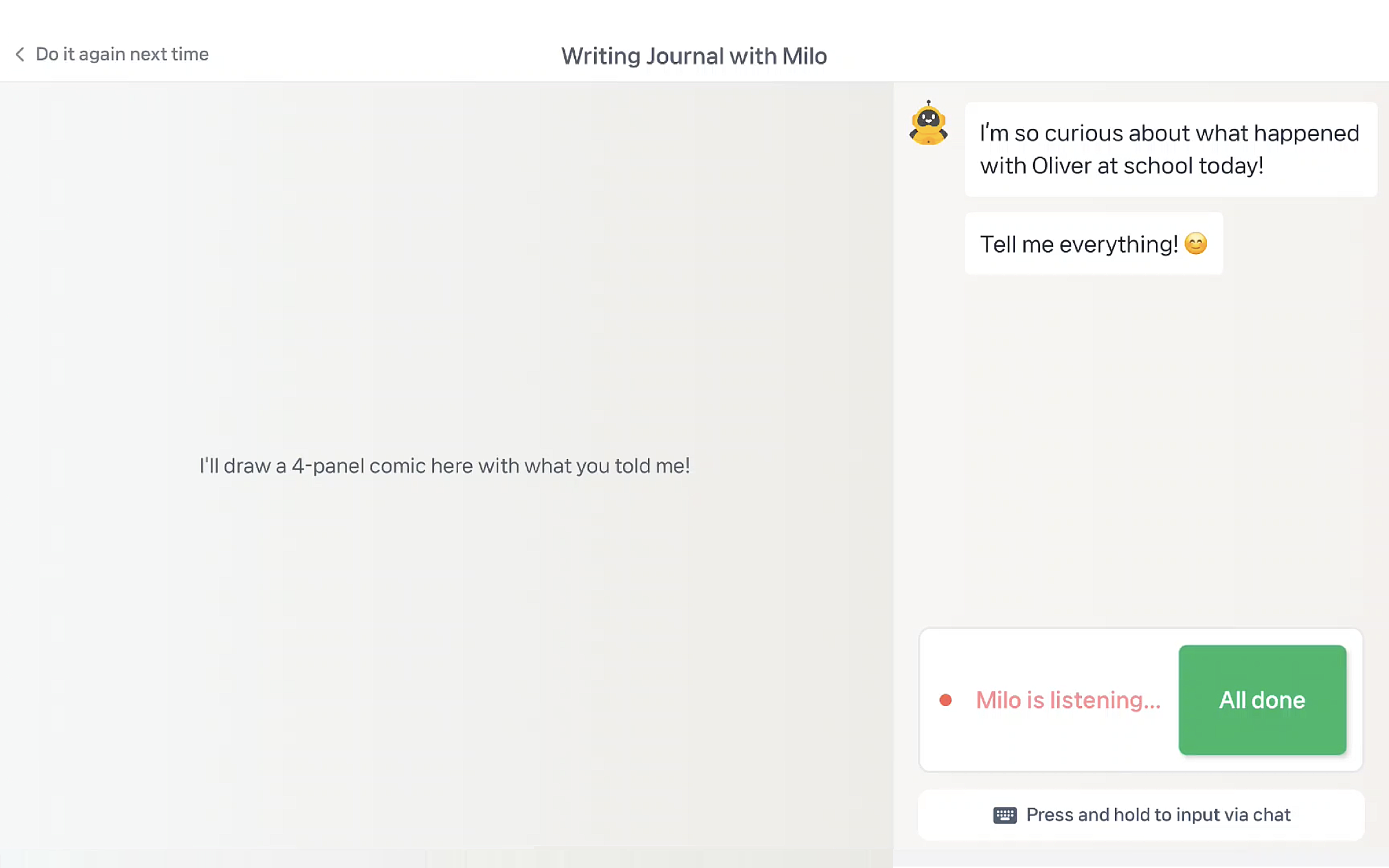
2. Articulation: The AI asks questions like “What happened with Yunsu at school?” to encourage the child to describe the event freely.
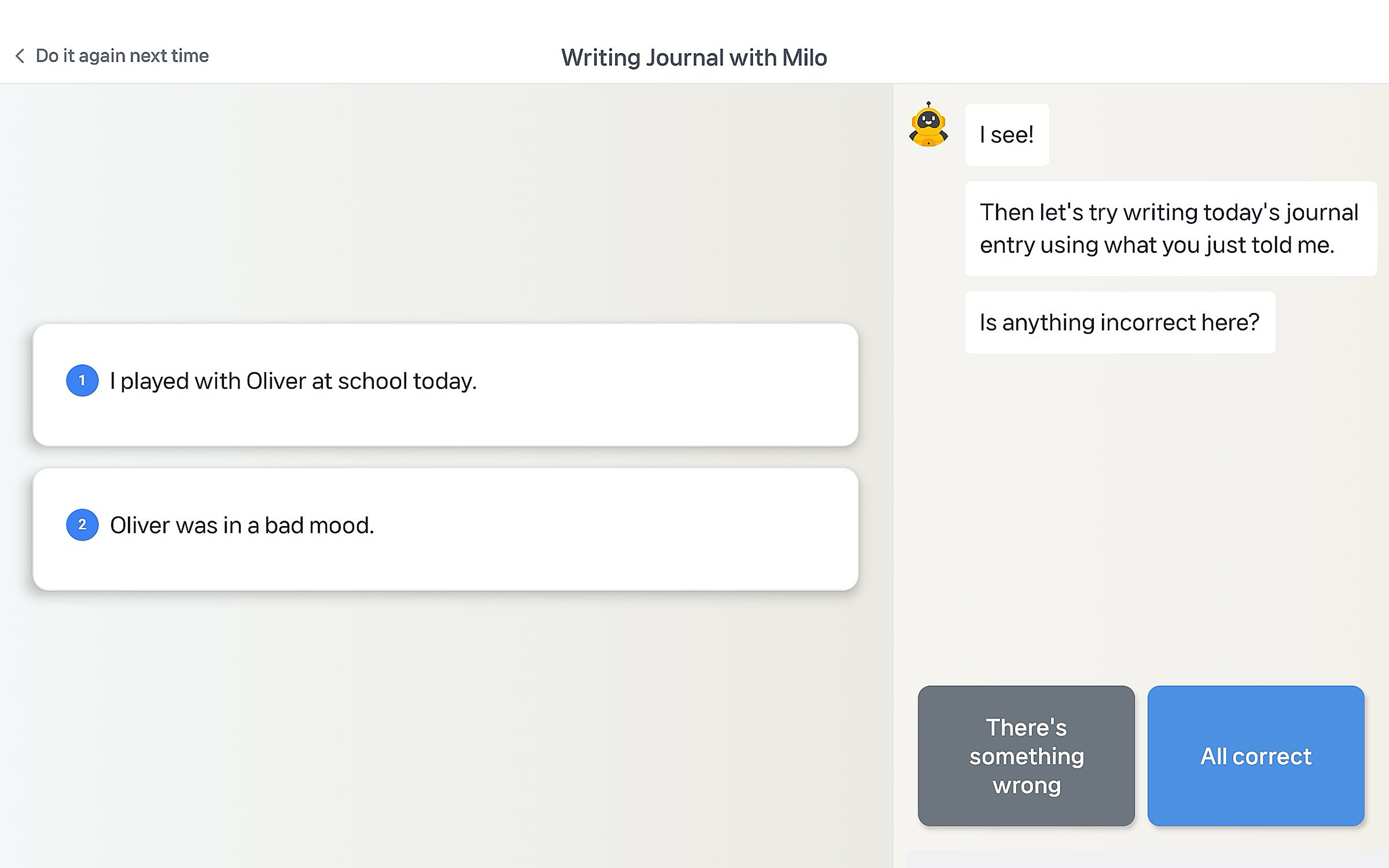
3. Verification: The AI segments the child’s response into the ABCE structure and presents it for review, letting the child confirm or correct any inaccuracies.
4. Elaboration: Based on the verified information, the AI generates only the comic panels it has enough detail for and asks follow-up questions to fill in any gaps.
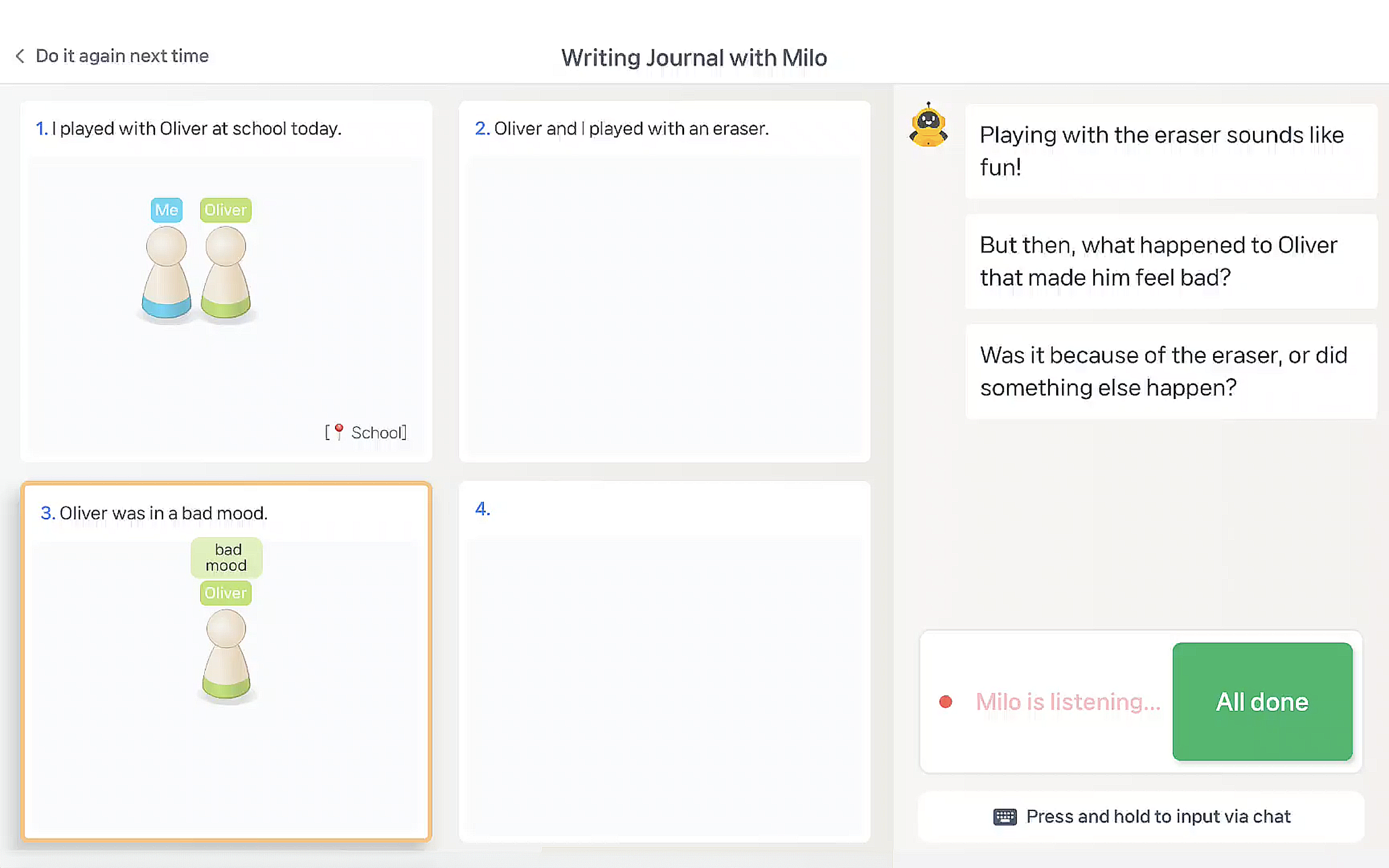
5. Revision: The AI combines all the collected information to complete the four-panel comic, and the child can make changes by speaking.
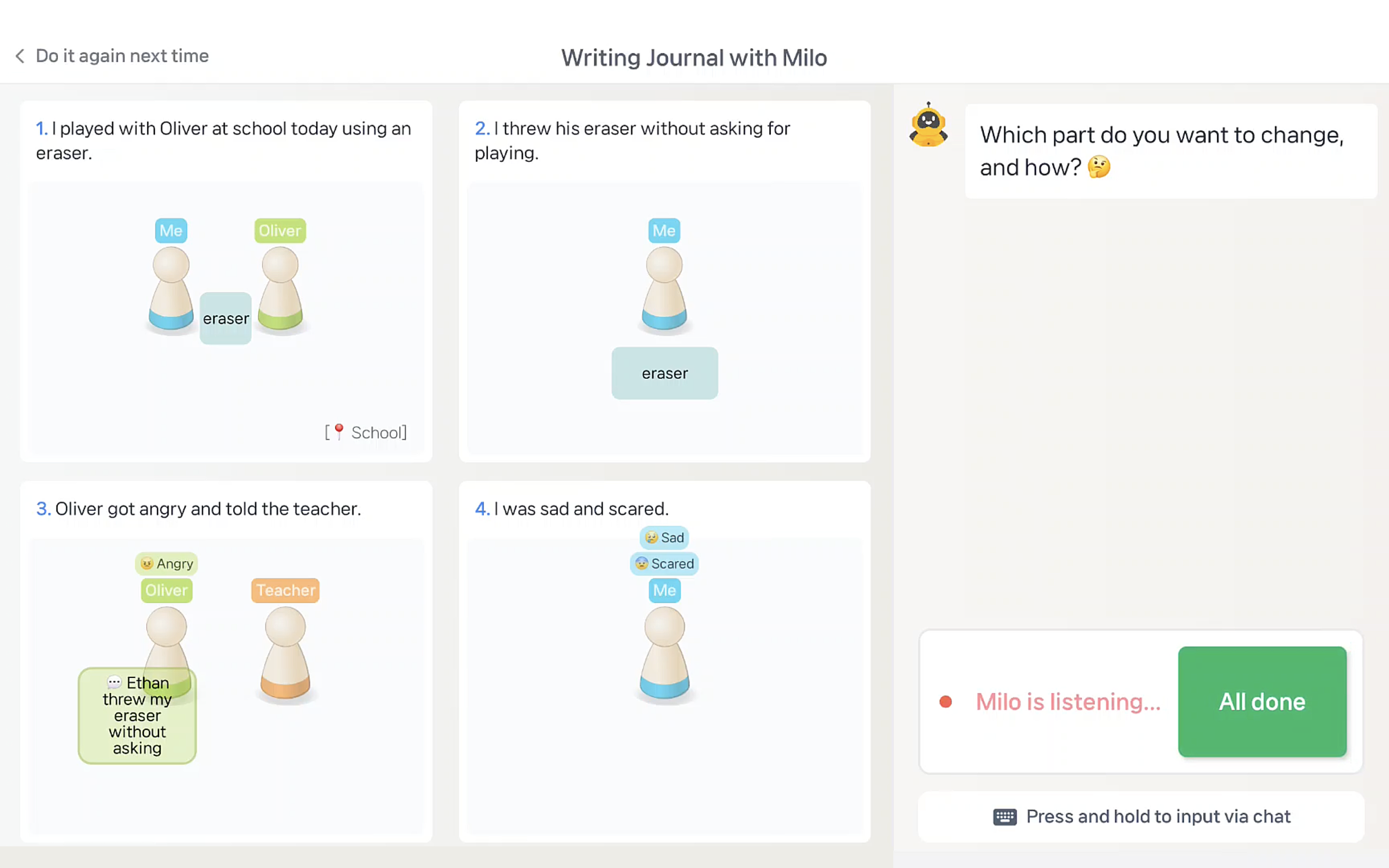
6. Wrap-up: The AI suggests a title, and the child finishes writing the journal entry.
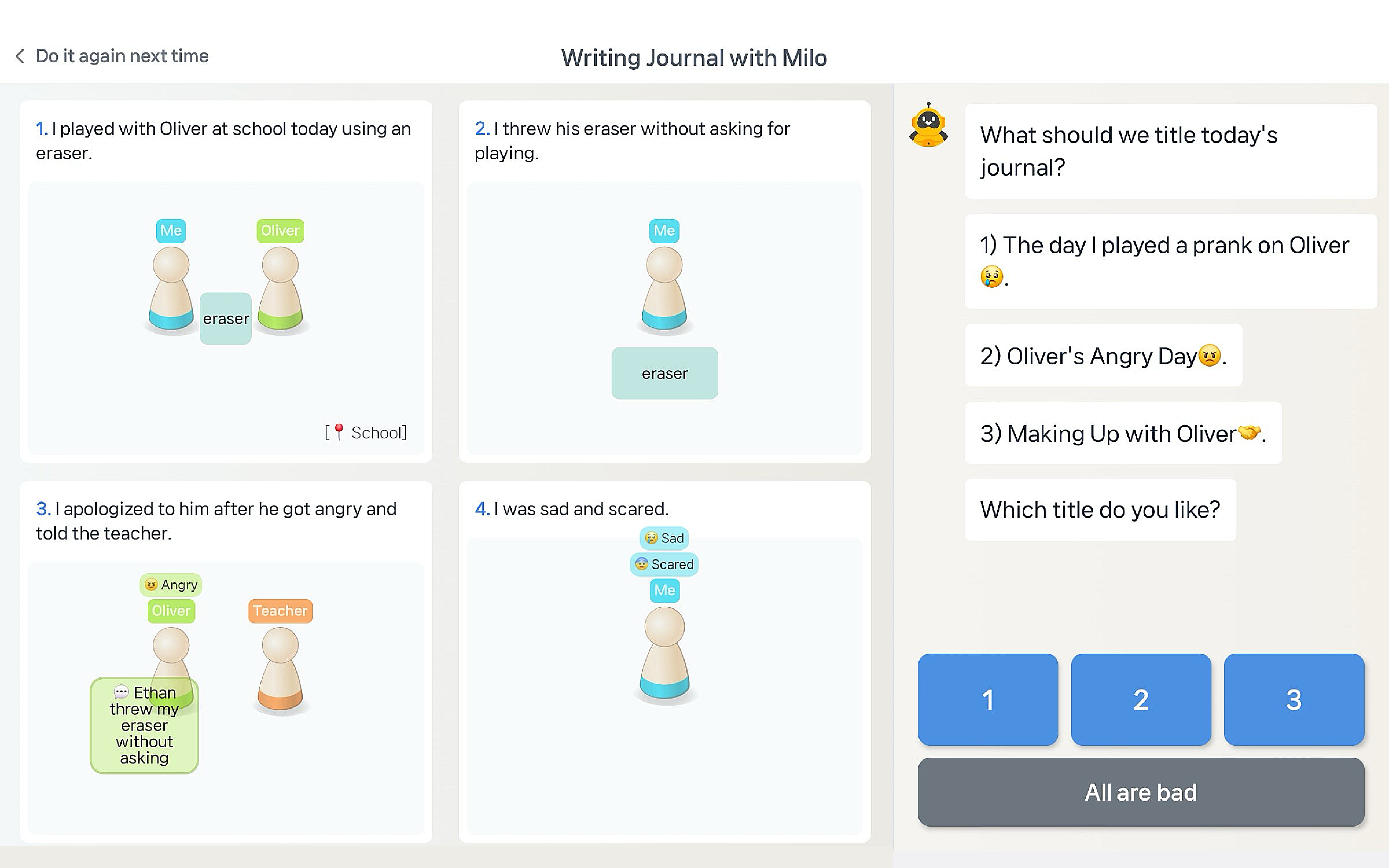
It might seem odd to start by choosing a place and people before describing what happened. But this is intentional: rather than opening with an open-ended question, having the child select the setting first reduces the cognitive load during the subsequent storytelling phase and makes it easier to recall specific memories.
Autistic individuals also tend to excel at following clearly defined routines, which gives them a sense of psychological comfort. With this in mind, we structured the journaling process as a step-by-step conversation so that children can easily recognize and internalize the pattern across repeated sessions.
Visual representation: Simplified visuals instead of image generation
Today’s generative AI can easily produce realistic images. But Autiverse deliberately avoids this approach in favor of simplified visuals. Autistic individuals often focus intensely on specific visual details, so if the comic panels contained detailed backgrounds or expressive character faces, children might fixate on those elements and lose track of the story itself. Expert interviews consistently confirmed that overly detailed illustrations risk drawing attention away from the comic’s content to the images themselves.
A hint from ‘expressionless wooden dolls’ in counseling
This design direction was further shaped by observations from real counseling practice. The office of Lee Kyungah, co-author of the study and director of Dodakim Child Development Center, is filled with wooden toys, dollhouses, and other miniature props. She uses them as visual aids during sessions with autistic clients to help elicit situational details—placing wooden figures on a desk and saying, “This is school, and this is your friend” to recreate situations.
This gave us a key insight. The wooden figures used in therapy have no facial expressions or fine details—they’re simple in form. This simplicity helps children focus on what the situation is and what happened rather than getting absorbed in the details of the figures themselves.
Drawing on this insight, we modeled the characters in Autiverse’s comics after Waldorf-style wooden figures, keeping them intentionally simple. This helps children stay focused on the situation and the story of their comic journal.
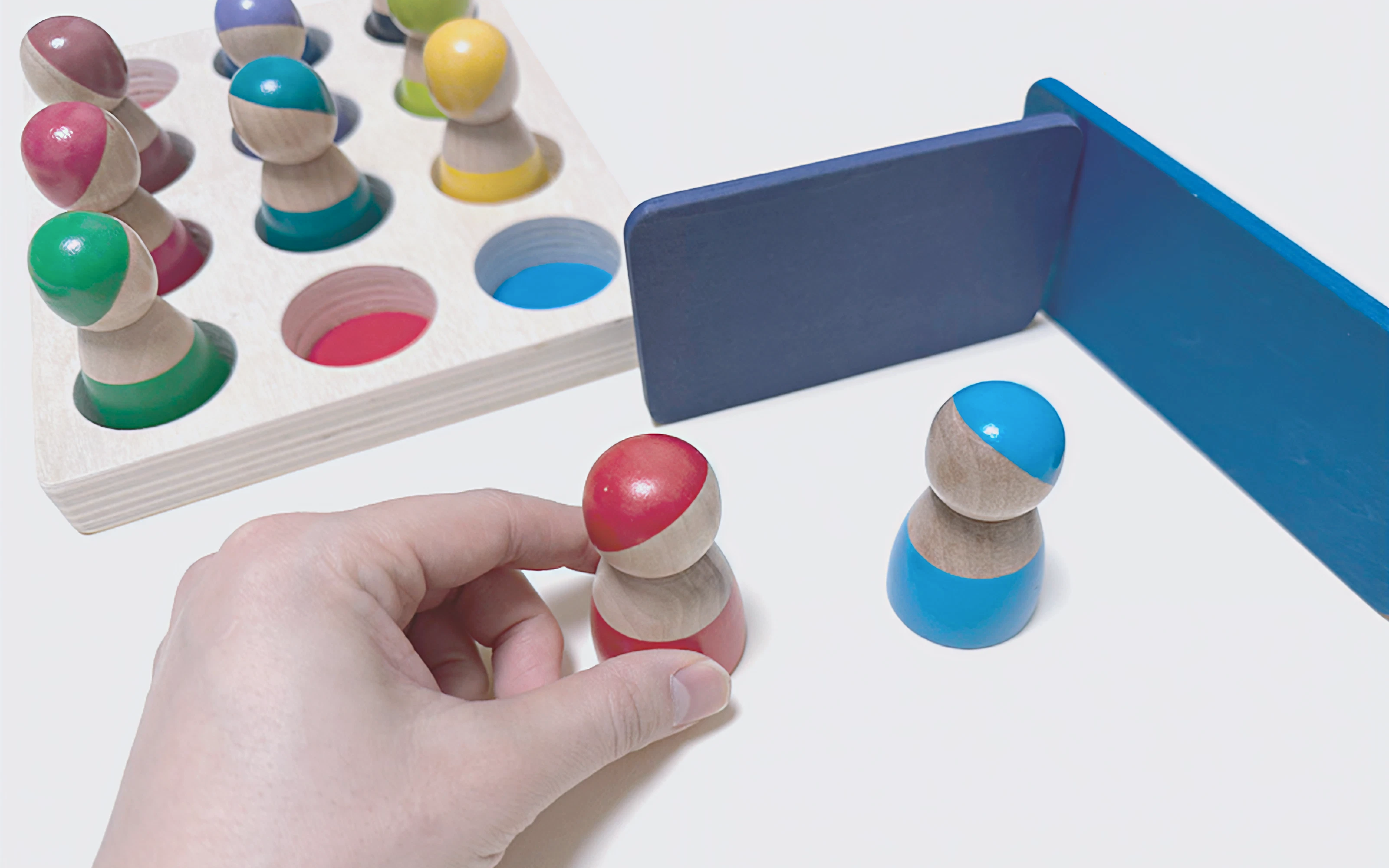
Waldorf-style educational toys used in therapy to help autistic clients describe situations
(photo taken on site)
AI as a peer friend, not a teacher or therapist
Another key consideration in designing Autiverse’s interactions was the role of the AI. A conversational AI can take many forms—a general-purpose chatbot like ChatGPT, or a character with a specific role such as a teacher or counselor. We gave Autiverse the role of a virtual peer instead. Autistic adolescents tend to become defensive with authority figures like parents, teachers, or therapists, because they feel they’re being evaluated. A peer-like AI sidesteps that dynamic, drawing out the child’s story naturally rather than from a position of authority.
We also made the AI’s avatar image and voice freely customizable using the CLOVA Speech engine. This lets users interact with an AI they feel comfortable with, making it easier to stay engaged in the journaling process.
User study: Testing Autiverse in real home environments
To see how Autiverse works in practice, we conducted a user study with 10 autistic adolescent–parent pairs over a two-week period. The study took place not in a lab but in the participants’ actual homes. The adolescents used Autiverse daily to write journal entries, and one parent sat nearby as a safeguard in case of AI malfunctions or safety issues. The study was designed so that parents would avoid intervening, allowing us to observe how the child and the AI interacted naturally. During the study period, we collected system usage logs and conducted surveys and interviews with both parents and adolescents after the two weeks to understand the experience from both perspectives.
High levels of engagement
All 10 adolescents completed the full two-week journaling period without dropping out.
- An average of 12.2 journal entries written (out of 14 days)
- 4 out of 10 participants journaled every single day for 14 days
- An average of about 9 minutes per session
The journal entries covered a wide range of topics. Children didn’t just write about after-school classes or things that happened at school—they also recorded family dinners out, hobbies like bowling and badminton, and even conflicts with friends.
Structuring narratives through step-by-step AI dialogue
Analysis of Autiverse’s conversation logs revealed that children’s stories were gradually constructed through the AI’s step-by-step questioning. Of the four ABCE panels, A (Antecedent) and B (Behavior) tended to be mentioned early in the conversation. This is consistent with the tendency of autistic individuals to focus first on concrete, observable facts.
In contrast, C (Consequence) and E (Emotion) tended to emerge later, often only after the AI asked targeted questions. 60% of C panels and 86% of E panels were first mentioned during the Elaboration phase—the stage where the AI digs deeper with follow-up questions after showing an initial comic strip draft. This shows that consequence and emotion are difficult to elicit with a simple question like “How was your day?”—and that the AI’s step-by-step guidance was what made it possible.
In 83% of journal entries, the B (Behavior) panel continued to be revised and refined even after its initial mention. Children weren’t just giving quick, dismissive answers to the AI’s questions—they were actively using the prompts to flesh out their experiences.
What parents discovered through their children’s journals
Most parents in the study accompanied their children to after-school activities or communicated with teachers daily, so they believed they already had a good understanding of their child’s routine. But after reading journal entries created through Autiverse, parents consistently reported learning about emotions and experiences they hadn’t known about. In daily surveys, more than half of parents said they learned something new about what happened to their child that day. A similar proportion said they discovered emotions they hadn’t been aware of.
One parent discovered through the journal that their child’s anxiety had led to smashing a keyboard. Another realized that an amusement park visit they thought was fun had actually been a frightening experience for their child.
A catalyst for everyday conversation
There were unexpected positive effects as well. Several parents said Autiverse opened the door to deeper conversations with their children. By looking at the completed four-panel comic journal together, they naturally began talking in more detail about what happened that day. The journal served as a bridge for conversation, turning scattered fragments of their day into richer, more detailed stories.
In some cases, children who previously only talked about video games began sharing a variety of everyday stories on their own. Other parents said the journals gave them opportunities to praise and encourage their child’s efforts. Several parents said they wanted to keep journaling with their children even after the study ended.
Conclusion
Through this research, we found that AI can serve not only as a tool to help autistic adolescents with journaling, but also as a bridge that naturally extends communication between parents and children.
NAVER will continue this line of research—helping autistic adolescents better tell their stories and connect more deeply with their families. For more details, please refer to the full paper.